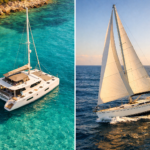
It is one of the first decisions you face when booking a sailing charter, and it divides sailors more reliably than almost any other topic. Catamaran or monohull? Both will get you to the same anchorages. Both will give you the same sunsets. But the experience of getting there — and living aboard while you do — is different enough that the choice genuinely matters.
Here is an honest breakdown of both, built for sailors who want to make the right call rather than simply justify the one they have already made.
What You Are Actually Choosing Between
A monohull is a single-hulled sailing yacht — the shape most people picture when they think of a sailing boat. It heels when the wind fills the sails, moves through the water with a motion that is deeply familiar to anyone who has sailed, and has been the default form of the sailing yacht for as long as sailing yachts have existed.
A catamaran has two hulls connected by a wide bridgedeck, on which the saloon and cockpit sit. It does not heel in any meaningful sense. It floats on top of the water rather than cutting through it, and the living space it offers — particularly on a charter catamaran of 40 feet or more — is in a different category from anything a comparably priced monohull can provide.
Understanding why each hull form behaves the way it does is the foundation for making a genuinely informed choice.
The Case for a Catamaran
There are compelling reasons why catamaran charter has grown dramatically over the past two decades, and they are not primarily about sailing performance.
Space and comfort at anchor
This is the catamaran’s defining advantage, and it is significant. A 42-foot catamaran offers roughly twice the living space of a 42-foot monohull. The saloon is wide, bright, and genuinely sociable. The cockpit is large enough to seat eight people comfortably around a table. Each hull typically contains two double cabins and a head, giving four couples genuine privacy from each other — a luxury that is essentially unavailable on a monohull of comparable length. For groups of six to eight people, the comfort difference is not marginal; it is transformative.
Stability
A catamaran does not heel. In flat water at anchor, it sits level. Under sail in moderate conditions, it still sits largely level, or heels very slightly to leeward. This has cascading practical benefits: cooking is straightforward on both tacks, glasses stay on tables, people who are prone to seasickness fare significantly better, and non-sailors in your crew can move around the boat without holding on. The stability also means that the large, flat cockpit and bridgedeck become genuinely usable social spaces even when sailing, rather than angled surfaces you brace against.
Shallow draft
Most charter catamarans draw between 1.0 and 1.3 metres of water — significantly less than a comparable monohull. This opens up a category of anchorages that monohulls simply cannot reach: shallow bays, sandy beaches where you can anchor in clear water close enough to wade ashore, and spots that are genuinely uncrowded precisely because deeper-keeled boats cannot access them.
Deck space and swimming platform
The wide bridgedeck trampoline at the bow — the mesh net stretched between the two hulls forward of the saloon — is one of the great pleasures of catamaran sailing. Lying on the trampoline at sea, watching the water pass beneath you and the bow waves from both hulls converging below, is an experience with no monohull equivalent. The wide sterns also typically feature large swim platforms at water level, making getting in and out of the water easy and safe for all ages.
The Case for a Monohull
The catamaran’s advantages are real and well-documented. The monohull’s case is quieter, less easily quantified, and — for sailors who care about sailing — considerably more compelling.
Sailing performance
A monohull, all else being equal, sails better than a catamaran. It points higher into the wind, performs more predictably in a range of conditions, and gives the helm a quality of feedback — the feel of the boat through the wheel or tiller, the response to sail trim, the connection between sailor and sea — that a catamaran largely eliminates. This matters enormously to sailors who came for the sailing. It matters much less to those who came for the destination.
Handling in strong winds
Catamarans are fast in moderate conditions and comfortable in light airs, but they require careful management in strong winds. The wide platform and relatively light displacement mean they can be difficult to manage when the wind builds above force 5–6, and the consequences of a catamaran broach or capsize are significantly more serious than those of a monohull knockdown. In the Aegean in a meltemi, or in open ocean conditions, an experienced sailor will generally feel more confident in a well-found monohull than in an equivalent charter catamaran.
Manoeuvrability in tight spaces
Catamarans are wide — typically 7–8 metres on a 42-foot boat — and this width can make tight marina manoeuvres genuinely challenging, particularly in crosswinds or strong currents. They also require more space at a dock or mooring and are not welcome in some smaller or more historic harbours that simply cannot accommodate them. Monohulls are more manoeuvrable, fit more easily into standard marina berths, and give the skipper more options when space is tight.
Motion at sea
This point divides sailors and depends heavily on conditions, but it is worth stating honestly: a catamaran’s motion at sea is not universally comfortable. In a seaway with waves on the beam, the bridgedeck slamming — the impact of waves against the underside of the connecting structure between the hulls — can be loud, jarring, and relentless. In the short, steep chop of the Aegean in a meltemi, it can be genuinely unpleasant. A monohull in the same conditions will heel and move with the sea in a way that many sailors find more harmonious, even if it is less stable.
Cost
A catamaran charter typically costs 60–90% more than a comparable monohull for the same week at the same base. For a group of four people, the maths often still favour the catamaran when the cost per head is calculated — but for smaller groups or tighter budgets, the premium is a real consideration.
Side by Side: The Key Differences
It helps to see the practical differences laid out directly.
Living space: The catamaran wins comprehensively. A 42-foot catamaran has roughly double the interior volume of a 42-foot monohull, with a wider saloon, larger cockpit, and genuinely private cabin arrangements for four couples.
Sailing experience: The monohull wins for sailors who prioritise the act of sailing. Better upwind performance, more helm feedback, and a connection to the water that catamarans do not replicate.
Stability: The catamaran wins. It does not heel, glasses stay on tables, and non-sailors find it dramatically more accessible.
Strong wind handling: The monohull wins. More predictable in challenging conditions, lower capsize risk, and more forgiving of mistakes in a seaway.
Shallow anchorages: The catamaran wins. Less draft means access to beaches and bays unavailable to deeper-keeled monohulls.
Marina access: The monohull wins. More manoeuvrable, fits standard berths, and is welcome in harbours where catamarans cannot go.
Cost: The monohull wins. Typically 60–90% cheaper than a comparable catamaran for the same week.
Seasickness: The catamaran wins for most people. The absence of heel and the greater stability reduces motion sickness significantly, though bridgedeck slamming can be a problem in rough conditions.
Who Should Choose a Catamaran?
A catamaran makes the strongest case in specific circumstances. It suits groups of six or more people where space, privacy, and communal comfort matter more than sailing performance. It is the right choice for mixed crews that include non-sailors, children, or people who are prone to seasickness, for whom the stability advantage is genuinely important. It works well for charters focused on warm, sheltered waters — the Greek Ionian, the Croatian islands in settled summer conditions, the Caribbean — where moderate winds and flat water play to the catamaran’s strengths. And it is the natural choice for anyone whose primary goal is life aboard at anchor rather than miles covered under sail.
Who Should Choose a Monohull?
A monohull makes the stronger case for sailors who came to sail. If the passage itself matters as much as the destination — if you want to feel the boat respond to your trim, point into a fresh breeze, and arrive somewhere with the satisfaction of a properly sailed passage — a monohull delivers that experience and a catamaran does not. It is also the better choice for smaller groups of two to four people for whom the space premium of a catamaran is unnecessary and the cost premium is hard to justify. For sailing in stronger or more variable conditions — the Aegean in summer, the Atlantic, anything offshore — the monohull is the more capable and forgiving sea boat. And for sailors who want access to the full range of marinas and harbours, including the smaller and more characterful ones, the monohull’s smaller footprint is a meaningful practical advantage.
The Honest Middle Ground
The charter industry’s dirty secret is that most people who charter catamarans in the Mediterranean are not making a sailing decision — they are making a holiday decision. They want space, stability, and comfort, and the catamaran delivers those things superbly. There is absolutely nothing wrong with this, and it does not make the choice any less valid.
The sailors who choose monohulls and mean it are, by and large, the sailors for whom the sailing is the point. They accept the smaller cabins and the heel and the higher chance of a wet passage because those things are part of what they came for, not inconveniences to be minimised.
Knowing which category you fall into is the most useful thing you can do before you make the booking.
The best boat is the one that suits the trip you are actually taking, sailed by the people who are actually going. Choose honestly, sail well, and the hull form will take care of itself.