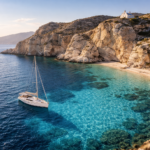
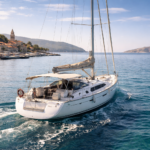
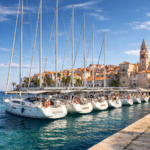
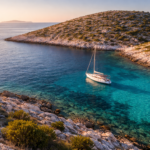
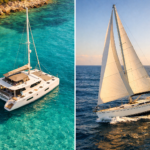
Greece is the other great Mediterranean charter destination — and in many ways the original one. With over 6,000 islands scattered across five distinct island groups, ancient harbours that have sheltered sailors for three millennia, and a sailing season that stretches from April to November, it offers a breadth and variety that Croatia, for all its charms, simply cannot match. Here is everything you need to plan a yacht charter in Greece from scratch.
Why Greece? Understanding What You’re Signing Up For
Greece is a bigger, more complex sailing destination than Croatia. The distances between island groups are longer, the winds are stronger and less predictable in parts, and the infrastructure — while improving — is less uniformly polished than the ACI marina network along the Dalmatian coast.
What Greece offers in return is extraordinary: raw, sun-bleached landscapes that feel ancient in a way that nowhere else quite does, a food culture that is genuinely world-class when you find the right taverna, and a sense that — even in high season — you can still sail around a headland and find a bay entirely to yourself.
The sailing grounds divide neatly into five main regions, each with a distinct character, and choosing between them is the first real decision of your planning process.
The Main Sailing Regions
Greece offers five distinct sailing areas, each with its own wind regime, island character, and ideal experience level. Understanding the differences between them is the most important planning decision you’ll make.
The Saronic Gulf
The Saronic is the most accessible Greek sailing ground, within easy reach of Athens and offering a compact cluster of islands — Aegina, Poros, Hydra, and Spetses — that can be covered comfortably in a week. It suits first-time Greek charterers well: the distances are short, the winds moderate, and Hydra in particular is one of the most beautiful harbours in the Mediterranean. The downside is proximity to Athens — the Saronic is busy, and the waters near Piraeus are congested with commercial traffic.
The Ionian Islands
The Ionian chain — Corfu, Lefkada, Kefalonia, Ithaca, Zakynthos, and the smaller islands in between — runs down the western side of Greece and is widely considered the finest sailing ground in the country. The winds here are dominated by the maestros, a reliable northwesterly that blows steadily through the summer and makes for some of the most enjoyable sailing in the Mediterranean. The landscape is green and lush compared to the arid Aegean, the anchorages are spectacular, and Lefkada — reachable by road bridge from the mainland — is the main charter base. This is the natural first choice for sailors coming from Croatia looking for a comparable experience.
The Cyclades
The Cyclades are iconic Greece: whitewashed villages on volcanic clifftops, deep blue domes, and a light that painters have chased for centuries. Mykonos, Santorini, Paros, Naxos, Syros, and dozens of smaller islands make up the group. The sailing, however, is demanding. The meltemi — the Aegean’s dominant summer wind — blows hard and persistently from the north between June and September, regularly reaching force 5–6 and occasionally beyond. The Cyclades rewards experienced offshore sailors who can handle a stiff breeze and a short, steep Aegean chop. It is not the place for a relaxed first charter.
The Dodecanese
Stretching along Turkey’s western coast, the Dodecanese — Rhodes, Kos, Symi, Patmos, Leros, and more — offer a combination of dramatic Turkish-influenced architecture, crystal-clear water, and some of the most varied island scenery in Greece. The meltemi blows here too, though often slightly less ferociously than in the open Cyclades. Rhodes and Kos are the main bases. The region suits experienced sailors who want a longer, more exploratory charter with fewer crowds than the Cyclades.
The Sporades
The four main Sporades islands — Skiathos, Skopelos, Alonnisos, and Skyros — sit in the northwestern Aegean and are less visited than the Cyclades or Ionian. The sailing is gentler than the open Aegean, the landscape is densely forested, and Alonnisos sits at the centre of Greece’s largest marine park. Skiathos is the main charter base and has a lively town, though the island itself gets crowded in August.
What Qualifications Do You Need?
Greece’s qualification requirements are broadly similar to Croatia’s, though the regulatory framework differs slightly. Make sure all documents are in order before you travel — port authority checks are routine and the paperwork requirements are taken seriously.
Sailing certificate The Greek Maritime Authority (HNLC) requires the skipper of a chartered vessel to hold a recognised certificate of competence. Widely accepted qualifications include:
- ICC (International Certificate of Competence) — the most universally accepted and strongly recommended
- RYA Day Skipper, Coastal Skipper, or Yachtmaster
- German SKS or SSS
- National licences from EU member states recognised under the UNECE framework
Greece also has its own national licence — the ΙKΑΝ (Ikan) — which Greek sailors use and which some charter companies accept from international visitors, though the ICC remains the cleaner option for foreign charterers.
VHF radio licence The Short Range Certificate (SRC) is required, as in Croatia. Greek waters use VHF Channel 12 as the primary working channel for port authorities, alongside the international distress channel 16.
Sailing experience Greek charter companies — particularly those operating in the Aegean — pay close attention to skipper experience. For Cyclades or Dodecanese charters, expect to be asked for a detailed sailing CV. Logged offshore passages, coastal miles in mixed conditions, and evidence of skippering boats of comparable size all carry weight. Yards in Lefkada for Ionian charters are generally more relaxed with intermediate-level sailors.
Crew list All vessels in Greek waters must carry a crew list stamped by port authorities. Your charter company will handle the initial registration, but you’ll need to update the list at each port you visit — more on this below.
Understanding Greek Waters: The Meltemi
Any sailor planning a Greek charter needs to understand the meltemi before they go. This is not a wind to be surprised by.
The meltemi is a strong, dry northerly or northwesterly wind that dominates the Aegean between June and September. It builds from the north as a thermal pressure system and typically follows a pattern: light in the morning, building through midday, reaching its peak in the afternoon, and dying back at sunset. In a typical year it blows at force 4–5 several days a week; during sustained meltemi episodes it can blow force 6–7 for days at a time.
For sailors heading south or southwest, the meltemi is exhilarating — fast, clear conditions with a spectacular sea running. Heading north against it in a full meltemi is hard, uncomfortable work. Planning your Aegean itinerary broadly from north to south, or using island chains as wind shadows, is the standard strategy for managing it.
The Ionian is largely sheltered from the meltemi by the Greek mainland and experiences a completely different wind regime — the gentler, more predictable maestros — making it a more forgiving choice for sailors who prefer Mediterranean-style conditions.
Costs: What a Greek Charter Actually Costs
Greek charter pricing follows a similar structure to Croatia, though there are some Greek-specific fees that catch first-timers off guard. Here is a full breakdown of what you will actually pay.
Base Boat Hire
| Boat Size | Low Season (Apr–May, Oct–Nov) | Mid Season (Jun, Sep) | Peak Season (Jul–Aug) |
|---|---|---|---|
| 38–40 ft | €1,000–€1,500/wk | €1,500–€2,200/wk | €2,200–€3,000/wk |
| 42–44 ft | €1,400–€2,000/wk | €2,000–€2,800/wk | €2,800–€3,800/wk |
| 46–50 ft | €1,800–€2,600/wk | €2,600–€3,600/wk | €3,600–€5,500/wk |
Catamarans attract a significant premium — typically 60–90% above comparable monohull prices — and are heavily booked in the Ionian in particular.
Greek-Specific Costs to Budget For
Beyond the base rate, several fees are unique to Greece and need to be factored in from the start.
TEPAI (transit log fee): Greece requires all chartered foreign vessels to carry a transit log, administered by the HNLC. The fee is calculated by boat length and duration; for a typical one-week charter on a 42-foot boat it runs to approximately €200–€400. Charter companies normally include this in the booking price, but always confirm.
Port fees: Greece’s official port system charges berthing fees that vary considerably. Municipal quays in smaller harbours are sometimes free or very cheap; private marinas in popular spots like Mykonos, Kos Town, or Corfu can charge €60–€100+ per night for a 42-footer in peak season. Anchoring off remains free and is widely practised.
Security deposit: €1,500–€4,000 depending on the vessel, held by card block or transfer and refundable at check-out. Deposit insurance is available from the same providers as in Croatia and strongly recommended.
Provisioning: Supermarket provisioning in Athens, Lefkada, or Rhodes is roughly comparable to Croatian prices. Island provisioning is more expensive, particularly in the Cyclades where everything is imported.
Fuel: Greek diesel prices are broadly in line with European averages. Budget for more motoring in the Cyclades than the Ionian, where the maestros handles most of the work.
The Overall Budget Rule
The same rule that applies in Croatia holds here: budget 50% above your base boat price to cover all mandatory fees, marina nights, fuel, and provisioning. A €2,500/week boat will realistically cost your group €3,500–€4,000 all in, before flights.
Main Charter Bases
Greece has charter bases spread across its five sailing regions, each suited to a different type of itinerary. The right base depends entirely on where you want to sail.
Lefkada (Ionian): The most popular bareboat charter base in Greece. Accessible by road from mainland Greece, it has two large well-equipped marinas — Lefkada Town and Nidri — and sits at the heart of the finest sailing ground in the country. The vast majority of first-time Greek charterers start here.
Athens / Piraeus / Alimos (Saronic): Alimos Marina, south of Athens city centre, is the main Saronic charter base. Excellent for sailors flying into Athens who want to be on the water the same day. The marina is large, modern, and well-serviced.
Corfu (Ionian): Gouvia Marina on Corfu’s east coast is a well-equipped base for northern Ionian itineraries heading south toward Lefkada and the Ionian islands.
Rhodes (Dodecanese): Mandraki Harbour and the surrounding marinas are the jumping-off point for Dodecanese itineraries, with good flight connections from northern Europe.
Kos (Dodecanese): A smaller base than Rhodes but well-positioned for central Dodecanese sailing, with good access to Symi, Patmos, and the Turkish coast.
Volos / Skiathos (Sporades): Volos on the mainland and Skiathos island are the two main bases for Sporades sailing.
Charter Operators
The Greek charter market is large and varied, ranging from well-known international brands to smaller local yards with decades of experience. These are the most established names worth considering.
International Operators
Sunsail operates a significant flotilla and bareboat programme out of Lefkada (Nidri) and is one of the best-organised options for first-time Greek charterers. Their flotillas are particularly well-suited to sailors who want company and support while still having independence.
The Moorings has bases in Lefkada and Athens, offering a well-maintained fleet of monohulls and catamarans at the premium end of the market.
Dream Yacht Charter operates across multiple Greek bases including Lefkada, Athens, and Kos, with a large and varied fleet.
Local and Regional Operators
Vernicos Yachts (Athens/Alimos): One of Greece’s oldest and most respected charter companies, with a large fleet and strong local knowledge of the Saronic.
Neilson: A UK-based operator offering flotilla sailing in the Ionian, particularly well-regarded for beginners and intermediate sailors.
Hellenic Charters: A well-established local operator covering multiple Greek bases with competitive pricing.
Booking Aggregators
The same platforms that cover Croatia — Sailogy, Sailing Europe, and Nautičar — carry strong Greek inventory. Boataround and Click&Boat are also worth checking for Greek-specific listings and sometimes surface smaller local operators not found on the larger platforms.
Port Formalities: What’s Different in Greece
Greece has more bureaucratic requirements than Croatia, and it pays to understand them before you arrive.
The transit log is your vessel’s official document in Greek waters. It is issued by the HNLC, stamped at your departure port, and must be presented at every subsequent port you visit. The harbour master (limenarchio) at each port will stamp it on arrival and departure. Keep it accessible — port authority checks are routine and the fines for not having it in order are real.
Port police (Limenarchio) are present at most harbours and marinas. They are generally helpful but can be particular about paperwork. Always check in with the port police or harbour master when you arrive at a new port, especially in smaller harbours where there is no marina office.
Crew list updates must be submitted at each port if your crew changes. In practice, on a straightforward charter with the same group throughout, you’ll simply present the stamped transit log and crew list at each stop.
Greece vs. Croatia: A Practical Comparison
For sailors weighing up which destination to choose, the key differences come down to experience level, preferred sailing style, and what you want from the destination beyond the water.
Croatia suits intermediate sailors, shorter charters, those who prefer polished marina infrastructure, and anyone who wants reliable, gentle summer sailing conditions. The islands are compact and beautiful, the towns are well-preserved and welcoming, and the learning curve is gentle.
Greece suits more experienced sailors, longer charters, those willing to engage with stronger winds and more variable conditions, and anyone drawn to a deeper, more varied cultural landscape. The Ionian is the exception — it offers Adriatic-style sailing in a Greek setting and is the natural bridge between the two countries.
Many sailors do Croatia first, Greece second. The progression makes sense.
Greece rewards sailors who come prepared and leave flexible. Plan your itinerary, understand the winds, respect the paperwork — and then be ready to abandon the plan entirely when you round a headland and find a bay so perfect you can’t leave it.