Navigation Lights: Rules and Recognition
The lights are a language with a fixed vocabulary. Learn the arcs, the ranges and the patterns, and a distant vessel tells you what she is and where she is going.
A single white light on a dark horizon tells you almost nothing. Two white lights, one above and behind the other, with a red glow beneath them, tells you a great deal: a power-driven vessel over 50 meters, showing you her port side, crossing from your right to your left. You have not spoken to her, you have no radar contact yet, and you already know what she is and roughly where she is going.
That is what the lights are for. They are a language with a fixed vocabulary, and every vessel at sea is required to speak it from sunset to sunrise. The officer who reads it quickly buys minutes. The one who hesitates, or guesses, gives those minutes away.
The Three Arcs That Divide the Horizon
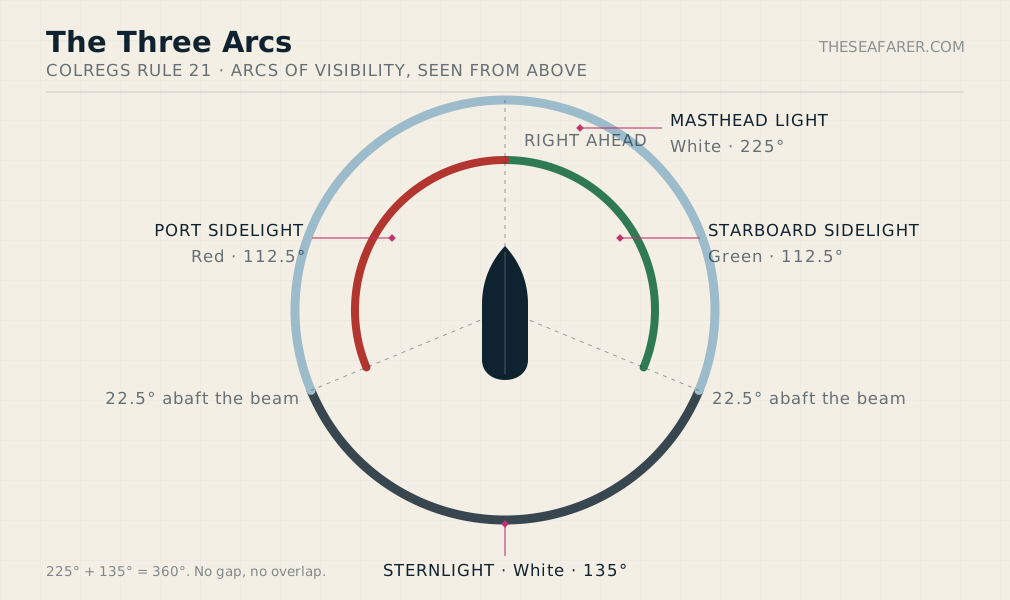
Everything in the system rests on one idea: a light is not visible all the way around. Each type of light is cut to a specific arc, and the arcs are chosen so that what you can see tells you which way the vessel is facing.
Rule 21 sets them out precisely. A masthead light is white, carried on the fore-and-aft centerline, and shows over an arc of 225 degrees, from right ahead to 22.5 degrees abaft the beam on either side. Sidelights are green to starboard and red to port, each covering 112.5 degrees, from right ahead to 22.5 degrees abaft the beam on their own side. A sternlight is white, placed as near the stern as practicable, and covers 135 degrees, 67.5 degrees from right aft on each side.
Add them up and the geometry falls out. The two sidelights together cover 225 degrees, exactly matching the masthead light. The sternlight’s 135 degrees fills the remainder, and 225 plus 135 is 360. The horizon around every vessel is divided without gap and without overlap.
Two more definitions complete the set. An all-round light shows through the full 360 degrees, and a flashing light flashes at 120 or more flashes per minute. Both appear constantly in the rules that follow, and neither tells you anything about aspect on its own.
What the Arcs Tell You About Aspect
Once the arcs are fixed, recognition becomes a process of elimination, and it is worth doing deliberately rather than by instinct.
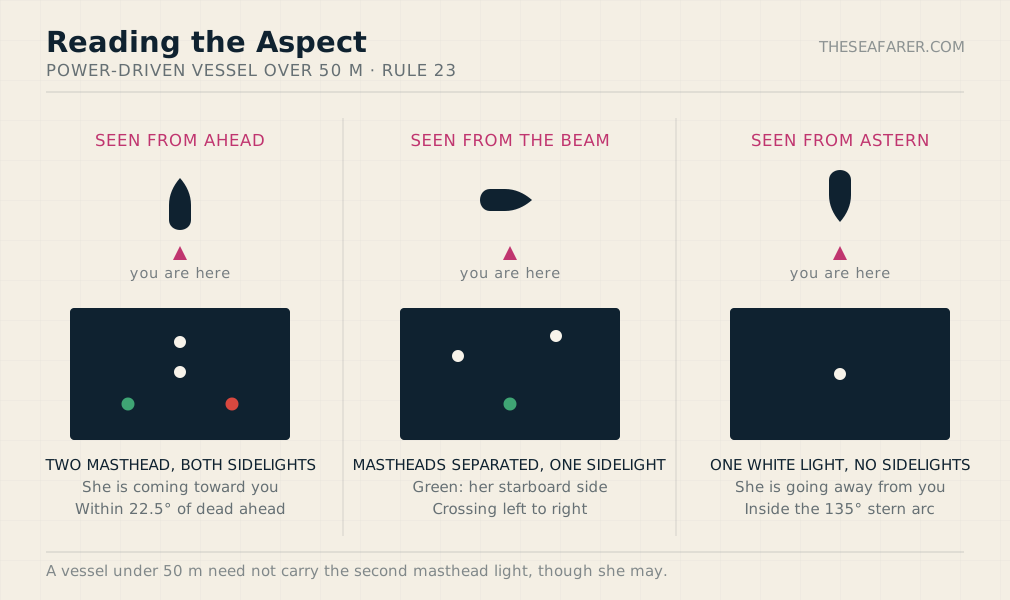
If you can see a masthead light and both sidelights, you are within 22.5 degrees of dead ahead of her, looking at her bow. She is coming toward you. If you see a masthead light and one sidelight, you are somewhere on that side of her: red means you are looking at her port side and she is crossing right to left, green means her starboard side and left to right.
If you see only a white light and no sidelights at all, you are behind her, inside the sternlight’s 135-degree arc, and she is going away. That single white light is the one most often misread, because a sternlight at a distance looks much like an anchored vessel’s all-round light, and the difference between overtaking a vessel and approaching a stationary one matters enormously.
The moment of transition is where attention is needed. As a vessel swings, a sidelight will cut out and the sternlight will appear, and that changeover happens at 22.5 degrees abaft the beam. Watching a light disappear is information, not an equipment fault.
How Far You Should See Them
Knowing the pattern is half the job. Knowing when you should expect to see it is the other half, and Rule 22 sets minimum ranges by the length of the vessel showing them.
A vessel of 50 meters or more must show a masthead light visible at 6 miles, with sidelights, sternlight, towing light and any all-round light visible at 3 miles. A vessel of 12 meters or more but under 50 shows a masthead light at 5 miles, reduced to 3 miles if she is under 20 meters, and everything else at 2 miles. Smaller vessels again have shorter ranges.
The practical value of this is inverse. If you can see a masthead light but no sidelights yet, she is probably still beyond 3 miles, because the masthead light carries further than everything else on a large ship. That gap between first sighting and full pattern is your earliest warning, and it is worth treating as such rather than waiting for the picture to complete itself.
The Power-Driven Vessel Underway
Rule 23 covers the vessel you will see most often. A power-driven vessel underway shows a masthead light forward, a second masthead light abaft of and higher than the first, sidelights, and a sternlight. A vessel under 50 meters is not obliged to carry the second masthead light, though she may.
That optional second light is one of the most useful things on the horizon. Two masthead lights in line mean 50 meters or more, near enough, and the vertical separation between them shows you her heading: as she turns, the lights open out or close together. When they are vertically in line you are looking at her bow or stern; when they are well separated, you are seeing her from the side.
A power-driven vessel of less than 12 meters may instead show a single all-round white light and sidelights, and one under 7 meters whose maximum speed does not exceed 7 knots may show an all-round white light alone, with sidelights if practicable. Air-cushion vessels in non-displacement mode add an all-round flashing yellow light.
Sailing Vessels and Vessels Under Oars
A sailing vessel underway shows sidelights and a sternlight, and nothing else. The absence of a masthead light is the whole signal, and it is the fastest way to tell sail from power in the dark.
This matters because the presence or absence of that white light changes who gives way under the steering and sailing rules. A vessel showing red or green with no white light above it is under sail, and a power-driven vessel is required to keep out of her way. A sailing vessel using her engine, whatever her sails are doing, is a power-driven vessel and must show masthead lights accordingly.
When a Vessel Cannot Get Out of Your Way
Some vessels are telling you they cannot do what the rules would otherwise require of them, and Rule 27 is how they say it.
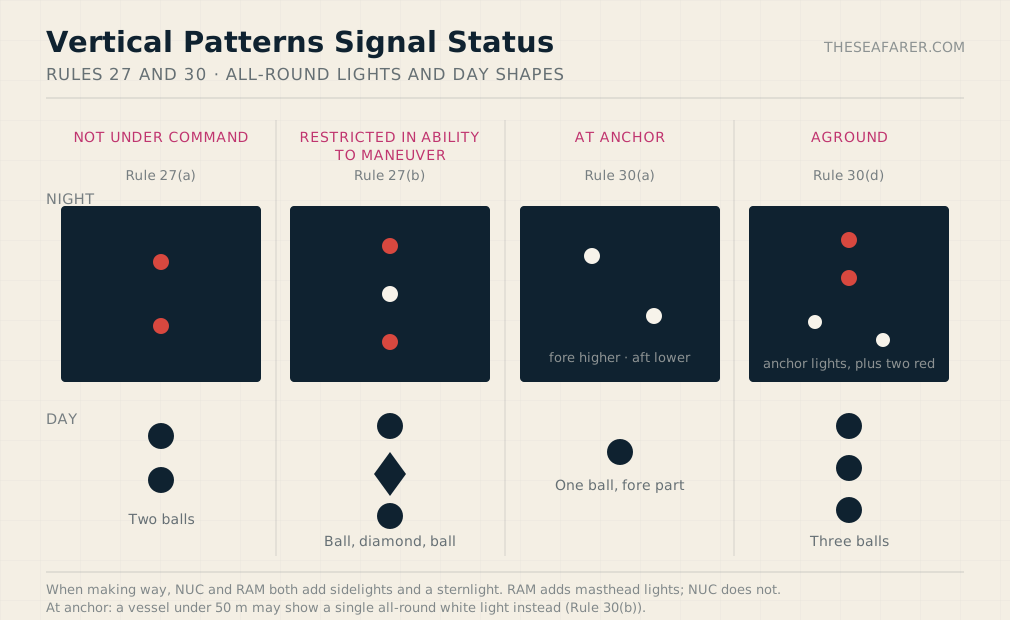
A vessel not under command shows two all-round red lights in a vertical line, and when making way through the water adds sidelights and a sternlight. She shows no masthead lights, and that absence is deliberate: she is not under control, and the pattern says so. By day she shows two balls.
A vessel restricted in her ability to maneuver shows three all-round lights in a vertical line, red over white over red, and when making way adds masthead lights, sidelights and a sternlight. Her day shapes follow the same rhythm: ball, diamond, ball. Cable-laying, dredging, replenishment at sea and similar work all fall under this.
The two are easy to confuse at a distance, and the difference is worth fixing properly. Two reds mean she has lost the ability to maneuver. Red-white-red means she is working and cannot deviate. Both mean the same thing for you in practice, which is that the burden of keeping clear has shifted onto your bridge.
At Anchor, and the Lights You Must Not Confuse
Rule 30 covers the vessel at anchor. She shows an all-round white light in the fore part, and a second all-round white light at or near the stern, lower than the first. A vessel under 50 meters may show a single all-round white light where it can best be seen.
Here is the recognition problem that catches people out. A small anchored vessel shows one white light. A vessel going away from you shows one white light. From a mile off in a dark anchorage they can look identical, and the difference between them is the difference between a stationary hazard and a vessel opening the range.
The answer is not to stare harder but to watch the bearing and check against something else. A stern light will change bearing as she draws away; an anchor light will not. This is one of the places where the picture on the radar display settles a question the eye cannot, and where a proper lookout means using every available means rather than vision alone.
When the Lights Must Burn
Rule 20 sets the timing, and it is stricter than most people assume. The rules on lights must be complied with from sunset to sunrise, and during those hours no other lights may be shown if they could be mistaken for navigation lights, impair their visibility, or interfere with keeping a proper lookout.
They must also be shown from sunrise to sunset in restricted visibility, and may be shown at any other time it is deemed necessary. Day shapes are a daytime requirement.
That last clause is worth taking seriously. If visibility is closing in and you are wondering whether to switch on, the rule already permits it and good practice suggests it. Deck lighting is covered by the same rule: floodlights left burning over a working deck can wash out your own sidelights from another bridge’s point of view, which is a real failure even though nothing is switched off.
Building the Recognition
Reading lights quickly is not a matter of memorizing tables. It is a matter of asking the same three questions in the same order every time, until the order becomes automatic.
First, what color and how many? That narrows it to a family. Second, are they vertical or horizontal? Vertical patterns are status, horizontal separation is aspect. Third, what is missing? The absent masthead light on a sailing vessel and the absent sidelights on a vessel not making way carry as much meaning as the lights that are there.
Practice on the real thing. An hour on a bridge wing in a busy anchorage, working out each vessel before checking against AIS, builds the reflex faster than any amount of reading. The terms used throughout are defined in the glossary if any of them are unfamiliar.
Frequently Asked Questions
These come up constantly, from cadets learning the arcs for the first time to officers confirming a detail before an oral exam.
Why is the masthead light 225 degrees and the sternlight 135?
Because together they cover the full circle without a gap. The masthead arc runs from right ahead to 22.5 degrees abaft the beam on each side, which is 225 degrees in total, and the sternlight covers the remaining 135. The sidelights split the same 225-degree forward arc into 112.5 degrees each.
How do I tell a sailing vessel from a power-driven vessel at night?
By the masthead light. A sailing vessel underway shows sidelights and a sternlight only. If you can see a white light above the sidelights, she is power-driven, including a sailing vessel motoring with her sails still up.
What is the difference between not under command and restricted in ability to maneuver?
Not under command is two all-round red lights in a vertical line, and by day two balls. Restricted in ability to maneuver is three all-round lights, red over white over red, and by day ball over diamond over ball. The first has lost control; the second is working and cannot deviate.
Can I tell a vessel’s size from her lights?
Partly. Two masthead lights indicate a vessel of 50 meters or more, since smaller vessels are not required to carry the second one, though they may. Minimum visibility ranges also scale with length, so a masthead light seen at 6 miles belongs to a large vessel.
When exactly do navigation lights have to be shown?
From sunset to sunrise in all weathers, and from sunrise to sunset in restricted visibility. They may also be shown at any other time it is considered necessary. Day shapes are required by day.