Radar Basics
A working guide to marine radar: how it builds its picture, how to read motion and risk of collision from it, how to tune it, and where it goes blind.
A radar does not show you ships. It shows you echoes, bright smudges of returned energy on a dark screen, and the entire skill of using it lies in turning those smudges into a moving picture of the sea around you: which contact is opening, which is closing, and which one is quietly lining up to hit you. The set will paint a target the same whether it is a supertanker or a rain squall, and it will say nothing at all about a wooden fishing boat dead ahead.
Radar is the most valuable sensor on the bridge in fog and dark, and also the easiest to misread, which is why generations of seafarers have been taught to treat the picture not as truth but as evidence to be interpreted.
What Radar Actually Does
Marine radar works by pulse and echo. The antenna sends out a very short, powerful pulse of microwave energy, then listens; when that pulse strikes something and reflects back, the set measures the time the round trip took and converts it to a range, because radio energy travels at a known and constant speed. The direction the antenna is pointing at the instant the echo returns gives the bearing. As the antenna sweeps continuously through 360 degrees, the set assembles those ranges and bearings into the familiar circular picture, with own ship at the center.
Two things follow from how this works, and both matter in practice. First, radar measures range very accurately and bearing much less so, because the radar beam has width and smears a target slightly to either side, which is why a radar range is worth more than a radar bearing when you are fixing a position. Second, the strength of an echo depends on the target: a steel ship returns a strong, steady paint, while a low wooden hull, a fiberglass yacht, or a growler of ice may return almost nothing. The screen is a map of reflectivity, not of reality.
X-Band and S-Band: Why Ships Carry Two
The most useful thing a newcomer can learn about radar is that there are two kinds, and a SOLAS ship carries both for good reason. X-band radar, around 9 GHz with a wavelength near 3 cm, gives a sharp, detailed picture, picks out small targets and buoys, and is the band that triggers radar beacons and search-and-rescue transponders. Its weakness is weather: the short wavelength is scattered by rain and by the sea surface, so an X-band picture clutters up badly in bad conditions, exactly when you need it most.
S-band radar, around 3 GHz with a wavelength near 10 cm, is the opposite. It shows less fine detail, but its longer wavelength punches through rain and sea clutter and holds onto targets in heavy weather and at long range when the X-band screen has turned to mush. The practiced watchkeeper chooses the band to suit the moment, reaching for X-band detail in clear weather and pilotage and falling back on S-band penetration when it comes on to rain or blow. Knowing which band to trust in which conditions is a basic, and one the glossy summaries usually skip.
Reading the Display: Orientation, Motion, and Stabilization
A radar picture can be arranged in several ways, and confusing them is a classic error. Orientation is which way is up: head-up puts the ship’s heading at the top, so the picture swings as she yaws; north-up locks the display to the compass so it reads like a chart and is generally the steadier choice; course-up splits the difference. Motion is how movement is shown: in relative motion, own ship stays fixed at the center and everything moves relative to her, while in true motion own ship travels across the screen and each contact moves at its own true course and speed.
The subtle trap is stabilization. A display can be stabilized to the water or to the ground, and for collision avoidance you want the relative motion that determines risk, not the ground track. A target’s vector that looks reassuring because it is referenced to the seabed can hide a genuine close-quarters situation, so the rule is to know what your vectors are referenced to before you trust them. Around all of this sit the working tools: the range rings for judging distance, the heading marker for reading bearings against, and the electronic bearing line and variable range marker for measuring a specific contact precisely.
The One Thing Radar Is For: Risk of Collision
Strip radar back to a single purpose and it is this: telling you whether another vessel is going to hit you. The test is centuries older than the technology. If the compass bearing of a contact stays steady while the range between you falls, you are on a collision course. Constant bearing, decreasing range, and the radar makes that pattern visible in a way the naked eye in fog never could.
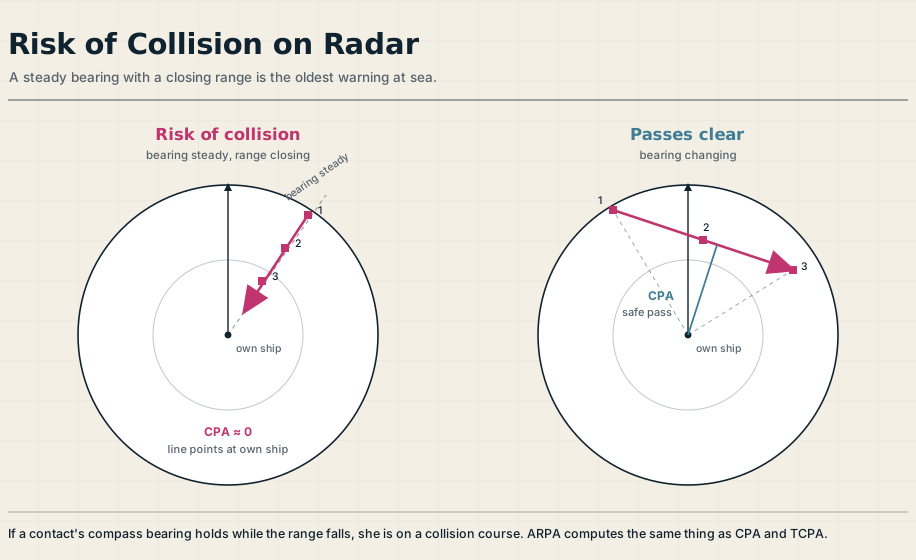
Plot a contact two or three times and the relative-motion line tells the story: extended, if it runs through or close to own ship at the center, the closest point of approach is small and the risk is real; if it passes well clear, she will go by at a safe distance. This is exactly what ARPA, the automatic radar plotting aid, does for you, acquiring targets and computing their course, speed, CPA, and the time to reach it, the TCPA. ARPA is a superb tool and a fallible one: it can swap two targets that cross, it lags for a minute or more after a target alters, and it loses contacts in heavy clutter, so its output is to be checked, not obeyed. And radar never overrides the rules. Information from it must be used in accordance with the COLREGs, which forbid action on scanty radar information, govern conduct in restricted visibility, and warn specifically against altering course to port for a vessel forward of the beam. The radar tells you a collision is developing; the Rules tell you what to do about it.
Tuning: Gain, Sea Clutter, and Rain
Radar is not a button, it is an instrument that has to be set up, and a badly tuned set is worse than useless because it inspires false confidence. Gain sets the receiver’s sensitivity: too high and the screen fills with speckle that buries real targets, too low and weak echoes vanish. Sea clutter control suppresses the ring of reflections thrown back by wave tops near the ship, and it is the most dangerous control on the set, because winding it up to clean off the clutter also deletes the small boat sitting in that clutter close aboard. Rain clutter control thins the haze of precipitation so you can see targets behind a squall, at the cost of softening target edges. The discipline is to tune so you can see the small, frightening target you are worried about, not to produce a tidy, empty picture that hides it.
Radar for Position Fixing
Radar earns its keep as a navigation tool as well as an anti-collision one. Because its ranges are so much more accurate than its bearings, the strongest radar fix comes from measuring ranges to two or three identified, charted features, a headland, an islet, a breakwater, and crossing them, rather than relying on bearings. In a channel the same principle drives parallel indexing, where a charted feature is used as a moving reference to hold the ship on a planned line. Radar ranges are also one of the best independent cross-checks on satellite position, a way of confirming that what GPS and the dead-reckoning plot are telling you agrees with the hard echoes of the coast, and they feed naturally into the wider picture the ECDIS holds. The one caution is identification: a radar fix is only as good as your certainty that the blob you ranged on is the feature you think it is.
What Radar Cannot Show You
A competent radar operator is defined as much by knowing the set’s blind spots as its strengths. Every ship has shadow sectors, arcs where masts, the funnel, or deck cargo block the beam and leave a blind area; these are known, measured, and posted on the bridge, and a contact can hide in one. Close around the ship is a minimum range inside which nothing shows at all. The beam travels in roughly straight lines, so radar cannot see beyond its horizon or over high land, and a low target drops below that horizon sooner than a high one. Some targets barely reflect at all, wooden and fiberglass craft, ice, and small boats among them, and a non-metallic hull can be invisible until it is dangerously close.
The picture is also prone to lies. Sea and rain clutter mask weak contacts, and the set can paint echoes that are not really there: multiple echoes between you and a close ship, side-lobe arcs, indirect reflections off your own structure, distant returns appearing at the wrong range. All of this is why radar must never be worked in isolation. The cautionary tale every navigator learns is of collisions that happened not despite radar but because of it, where watchkeepers read the screen with misplaced confidence and maneuvered into each other. Radar is one input among several, to be married to the lookout’s eyes, AIS, the chart, and plain seamanship, and it rewards the watchkeeper who reads it with respect for what it cannot see.
Frequently Asked Questions
These are the questions cadets and watchkeepers ask most about marine radar, from how it builds its picture to what it cannot show. Here are the short answers.
What is the difference between X-band and S-band radar?
X-band radar (around 9 GHz, 3 cm) gives a sharp, detailed picture and picks up small targets and radar beacons, but its short wavelength clutters badly in rain and rough seas. S-band radar (around 3 GHz, 10 cm) shows less detail but penetrates rain and sea clutter and holds targets in heavy weather and at long range. SOLAS ships carry both and the watchkeeper chooses by conditions.
How does radar show a risk of collision?
By the bearing of a contact. If its compass bearing stays steady while the range decreases, the two vessels are on a collision course. On a relative-motion display the contact’s plotted line runs toward own ship at the center, giving a small closest point of approach (CPA). ARPA computes the CPA and the time to reach it (TCPA) automatically.
Are radar ranges or radar bearings more accurate?
Ranges. Radar measures distance very accurately because it times the echo precisely, but the beam has width and smears a target in bearing, so bearings are less precise. For position fixing, a fix built from radar ranges to identified charted features is stronger than one built from radar bearings.
Why can’t I just turn up the anti-clutter controls for a clean screen?
Because the clutter controls delete real targets along with the noise. Winding up the sea-clutter control to clear the wave returns near the ship can also erase a small boat sitting in that clutter close aboard. The aim is to tune so the small, weak target you are worried about still shows, not to produce a tidy, empty picture.
What are radar’s main limitations?
Shadow sectors behind masts and cargo, a minimum range close around the ship, a horizon it cannot see beyond, weak or absent echoes from wood, fiberglass, ice, and small craft, clutter that masks targets, and false echoes that appear where no target is. For all these reasons radar must be cross-checked with the lookout, AIS, the chart, and other sensors, never trusted alone.