Voyage Planning Checklist: The Four Stages, Berth to Berth
A voyage plan is the thinking you do before the ship moves. A practical, berth-to-berth checklist across the four stages, so nothing on the passage becomes a surprise.
A voyage plan is not the line you draw on the chart. It is the thinking you do before the ship moves, worked through carefully enough that nothing on the passage arrives as a surprise.
SOLAS makes it mandatory, and the discipline behind it is the same on a coaster as on a VLCC: a plan built in four stages, covering the whole voyage from berth to berth. This is that plan as a working checklist.
At a Glance
Why a Voyage Plan Is More Than a Line
Under SOLAS Chapter V, every intended voyage must be planned in advance, and the plan has to cover the entire passage from berth to berth, including the waters where a pilot is aboard. The structure for doing it comes from the IMO Guidelines for Voyage Planning, which set out four stages: appraisal, planning, execution, and monitoring.
The point of all this is not paperwork. Investigations consistently find that human error lies behind the great majority of navigational accidents, and that the information needed to prevent them was usually aboard but never used. A voyage plan is how that information gets gathered, acted on, and shared, so the whole bridge team is working to the same picture, and the master approves it before the ship sails.
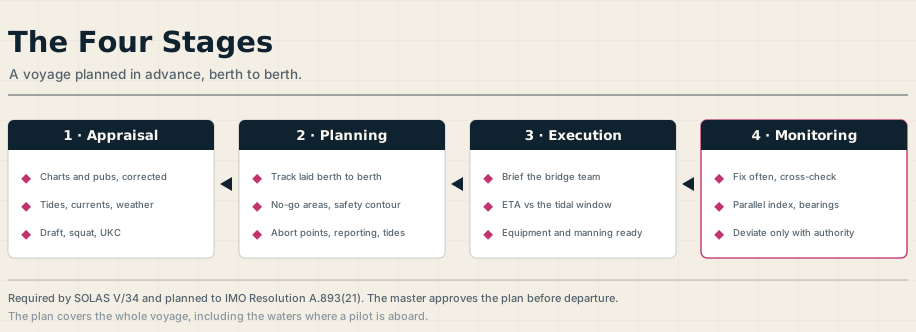
Stage 1, Appraisal: Gather Everything
Appraisal is the wide net. Before any track is drawn, you collect everything that bears on the passage and form a clear view of where it is safe to go and where it is not.
- Largest-scale charts and ENCs for the whole route, fully corrected, with coverage checked against the catalogue.
- Nautical publications: sailing directions, lists of lights and signals, tide tables and tidal stream atlases, radio signals, and routeing guides.
- Weather and climatology for the season, including ocean routeing advice where relevant.
- The ship’s own data: draft, air draft, squat, maneuvering characteristics, and load line zones.
- Routeing and reporting systems, traffic separation schemes, VTS areas, and expected traffic density.
- Navigational warnings, plus any company and charterer instructions and the master’s standing orders.
Stage 2, Planning: Lay the Track
With the appraisal done, the navigating officer lays out the detailed track on the master’s instructions, marking the charts clearly so that every danger and every margin is visible at a glance.
- The course lines plotted berth to berth, with distances, alteration points, and a cross-track limit defining the safe corridor for each leg.
- No-go areas shaded, and the ECDIS safety contour and safety depth set from the ship’s draft, not left at a default.
- Under-keel clearance checked at every shallow point, with tidal windows worked out where depth or height of tide governs the transit.
- Abort points and the point of no return marked, with contingency anchorages and boltholes identified.
- Parallel-index lines, clearing bearings and ranges, and the primary and secondary means of fixing the position for each stage.
- Reporting points, a speed plan and ETAs, and a route check run to confirm the track clears every charted danger before the master gives final approval.
A sound principle runs through this stage: a longer, safer route is always preferred to a shorter, more hazardous one.
Stage 3, Execution: Commit to the Plan
Execution is the decision to go, taken in light of the actual conditions on the day rather than the assumptions made when the plan was drawn. The plan is not changed lightly here, but it is pressure-tested against reality.
- ETA confirmed against tidal windows, daylight, and any port or VTS timing.
- Weather and visibility along the route reviewed against the forecast used in planning.
- Equipment checked for reliability, with the bridge and engine room readied and manning set for the demands ahead.
- Traffic density and fatigue considered, and the watch strengthened where the passage warrants it.
- The whole bridge team briefed on the plan, the contingencies, and each person’s role, with any change made only on the master’s authority.
Stage 4, Monitoring: Stay on It
Monitoring is the stage that never stops while the ship is moving. The plan exists to be checked against, continuously, so that any drift from it is caught early rather than discovered late.
- Position fixed at the planned intervals, by the primary method and confirmed by an independent one.
- The ECDIS or radar position cross-checked against visual bearings, with disagreement treated as a question, not a nuisance.
- Parallel indexing and clearing bearings used to confirm the ship stays inside the planned corridor.
- Soundings watched against charted depth, and the look-ahead and safety alarms left enabled.
- A full handover at every watch change, and any deviation from the plan made only with the master’s authority.
The Plan Is Only as Good as Its Use
A voyage plan filed and forgotten is worse than useless, because it gives the comfort of compliance without the substance of safety. The value is in using it: briefing it properly, navigating to it, and revising it the moment the charts change beneath it.
That last point matters more than it sounds. When charts are updated mid-voyage or a new notice lands, the affected legs need re-checking against the plan, because a fresh danger on an old track is exactly the kind of surprise the whole process exists to prevent. Run as a living routine rather than a departure formality, the four stages are what turn a line on a chart into a safe passage.
Frequently Asked Questions
These are the questions officers and cadets ask most about voyage planning, from the four stages to what the law requires. Here are the short answers.
What are the four stages of voyage planning?
Appraisal, planning, execution, and monitoring. Appraisal gathers all the information, planning lays the detailed berth-to-berth track, execution commits to the plan in light of the actual conditions, and monitoring checks the ship stays on it throughout. The four come from the IMO Guidelines for Voyage Planning.
Is voyage planning a legal requirement?
Yes. SOLAS Chapter V, Regulation 34, requires every intended voyage to be planned in advance, covering the whole passage from berth to berth, including pilotage waters. The detail follows IMO Resolution A.893(21), and bridge watchkeeping under it is governed by STCW.
What does berth to berth mean in voyage planning?
It means the plan must cover the entire voyage, from the departure berth to the arrival berth, with no gaps. That includes the open-sea passage, coastal and confined waters, port approaches, and crucially the waters where a pilot is aboard, which remain part of the plan rather than being left to the pilot alone.
Who approves the voyage plan?
The master. The navigating officer prepares the detailed plan on the master’s instructions, but the master reviews and approves it before departure and authorizes any significant deviation from it during the voyage.
What is the difference between voyage planning and passage planning?
In practice the terms are used interchangeably for the same berth-to-berth process and the same four stages. Where a distinction is drawn, “voyage” is sometimes used for the overall undertaking and “passage” for a single leg between two points, but both follow the appraisal, planning, execution, and monitoring structure.