IMO Model Course 1.27: ECDIS Training Explained
Generic ECDIS training has a name, and a catch. What IMO Model Course 1.27 covers, how it meets STCW, and why on its own it does not qualify you on your ship's ECDIS.
Passing IMO Model Course 1.27 does not, on its own, qualify you to navigate on your ship’s ECDIS. That catches a lot of people out, and it is the single most important thing to understand about the course.
Model Course 1.27 is the generic half of ECDIS training: the principles common to every system. The other half, learning the actual equipment on your bridge, is a separate requirement, and the two only count together.
At a Glance
What IMO Model Course 1.27 Is
IMO Model Course 1.27, titled “Operational Use of Electronic Chart Display and Information Systems,” is the ECDIS training curriculum published by the International Maritime Organization. It is not itself a certificate but a model syllabus, the template that training centers and flag administrations build their approved generic ECDIS courses on, so that a course taught in one country teaches the same core competencies as one taught in another.
In practice, it runs as a classroom and simulator course of around 40 hours, typically four to five days. The IMO first introduced it around the year 2000, well before ECDIS training was formally required, and it has been revised since to track the way the equipment and the rules have developed.
Why It Exists: ECDIS and the Manila Amendments
For years, there was no consistent requirement to train navigators on ECDIS at all. Some flag states demanded an approved generic course, others required nothing, and the quality of what existed varied wildly, which was an uncomfortable state of affairs for equipment that was becoming the primary means of navigation.
The 2010 Manila Amendments to the STCW Convention closed that gap by making ECDIS training a mandatory part of an officer’s qualifications on ECDIS-fitted ships. Model Course 1.27 is written to meet those requirements, mapping onto the competence standards in STCW Tables A-II/1, A-II/2, and A-II/3, which cover officers in charge of a navigational watch and masters and chief mates.
What the Course Covers
The syllabus is built around using ECDIS safely rather than admiring it. It works through the principal types of system and how their displays differ, the distinction between a full ECDIS and a lesser electronic chart system, and the legal side of compliance, before moving into the chart data itself: ENCs and RNCs, how they are loaded, and how they are kept up to date.
From there it turns operational. Trainees practice route planning and route monitoring, learn how the sensors and alarms work, and are drilled in the errors that matter most, both errors in the displayed data and errors of interpretation by the person reading it. A recurring theme runs through all of it, captured in one of the course’s own learning points: that ECDIS must never be relied upon as the sole aid to navigation, and that the traditional skills of cross-checking and watchkeeping still apply.
Generic vs Type-Specific: The Half That Catches People Out
Here is the distinction that the whole subject turns on. Model Course 1.27 is deliberately generic: it teaches the principles shared by all ECDIS, not the workings of any one manufacturer’s box. The course documentation says so plainly, stating that it requires complementary, structured, ship-specific familiarization on each ECDIS a navigator actually serves on.
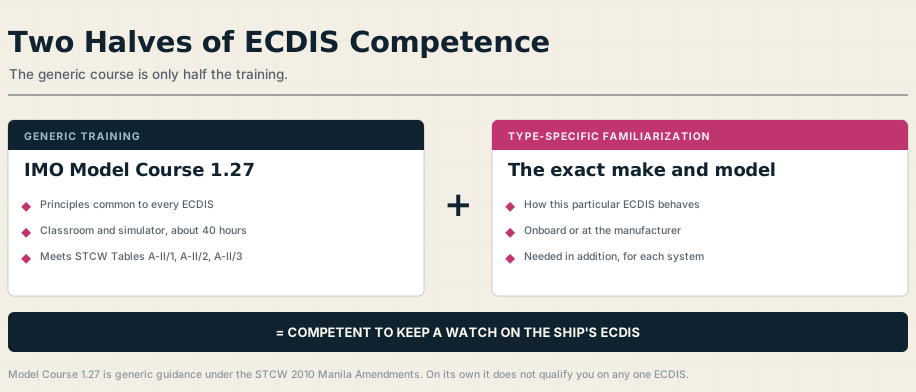
This matters because, as anyone who has joined an unfamiliar bridge knows, two type-approved systems can demand quite different keystrokes to do the same job. Setting a safety contour, acknowledging an alarm, or checking a route works differently from one maker to the next, so generic knowledge alone is not enough to operate the specific unit in front of you. The type-specific training fills that gap, and it is required in addition to the generic course, separately, for each different system. Competence to navigate on a particular ship’s ECDIS is the two halves together, never just the certificate from the classroom.
Who Needs It, and What You Walk Away With
The course is aimed at deck officers who keep a navigational watch, along with masters and chief mates, on ships fitted with ECDIS, which today is the great majority of the merchant fleet. For anyone building a career as a deck officer, it has become a standard part of the stack of STCW certificates that go with the licence.
What you leave with is a generic ECDIS training certificate, accepted by flag administrations as meeting the STCW requirement. It is worth knowing that the quality of delivery genuinely varies between providers, from hands-on courses with a simulator per student to crowded classrooms with a single shared screen, so a course that is well equipped and properly run is worth seeking out. The certificate proves you understand ECDIS in principle, and then the ship, and its particular system, finish the job.
Frequently Asked Questions
These are the questions officers and cadets ask most about IMO Model Course 1.27, from what it qualifies you to do to how it differs from type-specific training. Here are the short answers.
What is IMO Model Course 1.27?
It is the IMO’s model syllabus for generic ECDIS training, titled “Operational Use of ECDIS.” It is the template that training providers and flag states use to build approved generic ECDIS courses, taught over roughly 40 hours of classroom and simulator work, and written to meet the STCW requirements for navigating with ECDIS.
Is IMO Model Course 1.27 mandatory?
The course itself is guidance, but the training it provides is effectively required. Under the 2010 Manila Amendments to STCW, officers serving on ECDIS-fitted ships must hold generic ECDIS training, and an approved course based on Model Course 1.27 is how that requirement is met.
What is the difference between generic and type-specific ECDIS training?
Generic training, to Model Course 1.27, teaches the principles common to all ECDIS. Type-specific training teaches the actual make and model fitted to a particular ship, since interfaces and procedures differ between manufacturers. Both are required, and the generic certificate alone does not qualify you to operate a specific system.
How long is IMO Model Course 1.27?
It is commonly delivered over four to five days, around 40 hours, combining theory with practical exercises on ECDIS equipment or simulators. The exact length and quality vary between training providers.
Who needs IMO Model Course 1.27?
Deck officers in charge of a navigational watch, and masters and chief mates, serving on ships fitted with ECDIS. As ECDIS is now standard across most of the merchant fleet, generic ECDIS training has become a routine part of a deck officer’s STCW qualifications.