Watchkeeping Handover: What to Pass On
Two minutes decide whether the next four hours start with a clear picture or a gap nobody has noticed yet. What to establish, what to pass on, and when not to take the watch at all.
Most of a sea passage is uneventful, and the dangerous moments are rarely the ones that look dangerous. One of them happens eight times a day on every ship afloat: the two minutes when one officer stops being responsible for the vessel and another starts.
Handled well, nothing happens. The relief arrives with a clear picture, takes the watch, and the ship carries on. Handled badly, a target that was being monitored becomes a target nobody is watching, an alarm that was acknowledged for a reason becomes an alarm nobody understands, and the ship runs on for twenty minutes with a gap in her situational awareness that no one has noticed yet.
The short version
Satisfy yourself; do not simply be told. STCW puts the burden on the officer taking over: establish position, course, speed and draft from the chart and the window, check the weather and under-keel clearance as they are now, and work the traffic contact by contact.
Arrive early enough that your eyes have adjusted, read the master’s orders first, and ask what is pending. You do not take the watch mid-maneuver.
A Handover Is a Transfer, Not a Conversation
The distinction matters more than it sounds. A conversation is two people exchanging information and both walking away satisfied. A handover is one person taking on legal responsibility for a ship and everyone aboard her, and the moment it completes is a moment with consequences.
STCW frames it that way deliberately. The relieving officer must personally satisfy themselves about the state of the ship before taking the watch. Not be told. Not accept an assurance. Satisfy themselves, which means looking at the chart, looking out of the window, and checking the equipment rather than nodding along to a summary.
The outgoing officer’s job is to make that possible. The incoming officer’s job is to do it. Neither can do the other’s.
What You Must Satisfy Yourself Of
STCW sets out what the relieving officer has to establish before accepting the watch, and it is worth knowing the list well enough that you work through it without consulting anything.
You start with the master’s standing orders and any special instructions for the passage, because everything else is read against them. Then the ship herself: her position, course, speed and draft. Then the environment she is moving through, which means the prevailing and predicted tides, currents, weather and visibility, and specifically what those are going to do to your course and speed over the coming hours.
You establish the procedures for using the main engines when they are under bridge control, so that if you need them suddenly you are not working it out then. And then the navigational situation, which STCW breaks down further: the operational condition of every piece of navigational and safety equipment in use or likely to be used, the errors of the gyro and magnetic compasses, the presence and movement of every ship in sight or known to be in the vicinity, the conditions and hazards expected during the watch, and the possible effects of heel, trim, water density and squat on under-keel clearance.
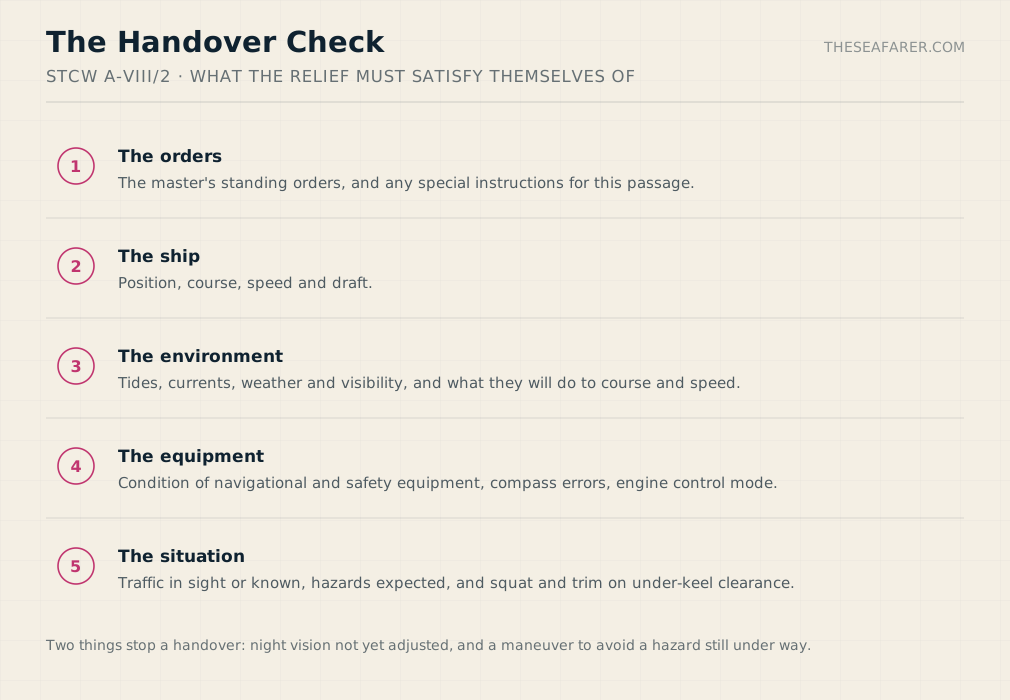
That last item catches people. Under-keel clearance is not a number you read once at the start of a passage. It changes with the tide, with the ship’s trim as fuel and ballast move, with the density of the water she is in, and with her own speed through shallow water. An officer taking over in the small hours in a shelving approach needs to know what it is now, not what it was at noon.
The Requirement Everyone Forgets
There is one provision in the handover rules that almost nobody thinks of as a rule, and it is the one about eyes.
STCW says the relieving officer shall not take over the watch until their vision is fully adjusted to the light conditions. Coming onto a darkened bridge from a lit alleyway, you are effectively blind for several minutes, and the adjustment is not complete for considerably longer than most people assume. During that window you cannot see a small unlit target, you cannot see the loom of a light on the horizon, and you may not see the ship you are about to be told about.
The practical answer is to arrive early and stand in the dark. Officers who take handovers seriously come up ten or fifteen minutes before the hour, let their eyes settle, and use the time to build the picture from the displays and the window rather than from the other officer’s account of it. The ones who arrive at four minutes to and take the watch on the hour are relieving blind and hoping nothing is close.
The Handover You Do Not Take
Two situations require you to stop, and both are written into the rules rather than left to judgment.
The first is capability. The officer on watch shall not hand over to a relieving officer if there is reason to believe that officer is not capable of carrying out the duties effectively, and the master is to be notified. That covers fatigue, illness and impairment, and it is written as an obligation on the outgoing officer, not a courtesy. Handing over to someone visibly unfit and going below is not a neutral act.
The second is timing. If the relief falls due while a maneuver or other action to avoid a hazard is under way, the relief is deferred until that action is complete. You do not change command in the middle of a course alteration for a close-quarters situation. The officer who started the maneuver finishes it, and the handover happens afterward, when there is something stable to hand over.
Both of these are easier to apply if you have decided in advance that you will. In the moment, at the end of a long watch, with your relief standing there, the pull toward “it will be fine” is considerable.
What the Outgoing Officer Owes
Everything above describes what the relief must establish. The other half of a good handover is what the officer going below actually gives them, and the difference between a useful handover and a poor one is almost entirely here.
Give the picture, not the data. “We’re on 047, twelve knots, next alteration at 0340” is data the relief can read for themselves. What they cannot read is that the fishing vessel to port has altered twice already and you do not trust her, that the radar has been throwing a false echo off the accommodation block since the rain started, or that you called the master an hour ago about the visibility and he asked to be called again if it dropped below two miles.
Say what you were worried about. If you have been watching something, say so and say why, because that judgment is the single most valuable thing you have and it is not recorded anywhere. If you did something unusual, say what and say why, so the relief does not undo it without knowing.
Say what is pending. A call booked with the engine room, a report due to the office at 0600, a pilot boarding at 0730 that will need the ladder rigged, a defect reported but not yet fixed. These are the things that go missing in a handover, because they are the things nobody thinks to ask about.
The Traffic Picture
Of everything passed over, the traffic picture decays fastest and matters most.
Walk it round properly. Take each contact in turn, say where it is, what it is doing, what its closest point of approach works out to, and what if anything you have decided about it. A contact that has been assessed and dismissed still needs mentioning, because the relief will otherwise reassess it from scratch and waste the first ten minutes of a watch doing work already done.
Then let the relief confirm it themselves. The radar picture and the COLREGs assessment that follows from it are the incoming officer’s responsibility from the moment they take the watch, and an assessment inherited without checking is an assessment nobody has actually made.
Write It Down
Almost every company requires a handover checklist, and almost every bridge has officers who treat it as paperwork. It is worth understanding why it exists.
A checklist does two things a conversation cannot. It makes the handover consistent regardless of who is giving it, which matters because officers vary enormously in how much they volunteer. And it creates a record of what was passed and when, which matters after an incident, when the question of what the incoming officer knew becomes a legal one.
The good habit is to complete it during the handover, not after. A form filled in at the end of the watch from memory records what you meant to say rather than what you said.
Why It Rewards the Effort
A handover is one of the few parts of watchkeeping where the standard is entirely up to the two people involved. Nobody is checking, the ship does not respond differently, and a poor handover produces no immediate consequence at all.
What it produces is a slightly degraded picture, carried forward into the next four hours, and then handed on again slightly more degraded. Most of the time that costs nothing. Occasionally it is the reason a contact was picked up late, or a defect was not passed on, or an approach was entered without anyone having recalculated the clearance. The discipline is cheap and the failure is not, which is the argument for doing it properly on the watches where nothing is happening. The rest of bridge watchkeeping is built on the same principle.
Frequently Asked Questions
These come up most often from cadets learning the routine and from officers preparing for orals.
What does STCW require before taking over a watch?
The relieving officer must personally satisfy themselves about the master’s standing orders, the ship’s position, course, speed and draft, the tides, currents, weather and visibility and their effect, the procedures for using the main engines on bridge control, and the full navigational situation including equipment condition, compass errors, surrounding traffic, expected hazards, and the effects of heel, trim, water density and squat on under-keel clearance.
Can you refuse to take over a watch?
Yes, and in some cases you must. If your night vision is not adjusted you may not take the watch until it is. If a maneuver to avoid a hazard is under way, the relief is deferred until that action is complete. Separately, the outgoing officer must not hand over to anyone they have reason to believe is not capable of carrying out the duties effectively, and the master must be told.
How long before the hour should you arrive on the bridge?
There is no prescribed time, but ten to fifteen minutes is the common practice and the reason is night vision. Arriving on the hour means taking the watch with eyes that cannot yet see what is out there, which is precisely what the rule on light adaptation exists to prevent.
What is the most commonly missed item in a handover?
Pending actions. Course, speed and traffic get passed reliably because they are obvious. Calls booked, reports due, defects reported but unrepaired, and instructions the master has given during the previous watch are the items that fall through, because the relief does not know to ask about them.
Is a written handover checklist required?
STCW sets out what the relieving officer must satisfy themselves of but does not itself prescribe a form. In practice almost every company’s safety management system requires a checklist, and completing it is part of the handover rather than a task to finish afterward.