Clove Hitch and Half Hitches: The Everyday Hitches
The knots you'll tie a hundred times a day. How the half hitch builds into two half hitches and the clove hitch, what each one is for, and when the clove hitch needs locking.
After the bowline, the next knots worth owning are the ones you will tie a hundred times a day. The half hitch and its relatives make a line fast to a post, a ring, or a rail in seconds, and the clove hitch, built from the very same move, is the workhorse for hanging fenders and starting a lashing.
The good news is that they are all the same simple action repeated. Learn the half hitch, understand how it stacks, and you have the whole family at once.
The Half Hitch: The Building Block
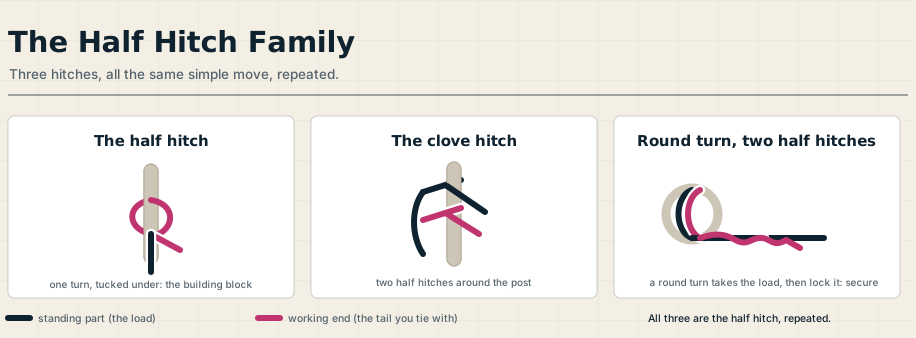
A half hitch is the simplest hitch there is: a single turn of the working end around something, the standing part or an object, passed under itself so it grips. If you have ever tied an overhand knot around a post, you have tied a half hitch.
On its own, a single half hitch is not secure and will not hold under any real load. Its value is as a building block, because almost every working hitch you use on deck is two or more half hitches combined in slightly different ways.
Two Half Hitches: Making a Line Fast
Tie a second half hitch immediately after the first, both around the standing part, and you have two half hitches, a genuinely useful knot. After passing the rope around a ring, rail, or post, the two hitches lock against each other and hold a steady load well, while still being easy to untie afterward.
This is the everyday way to make a line fast to a fixed point when the load is reasonably constant. It is reliable, quick, and adjustable, and it forms the basis of the more secure version that follows.
Round Turn and Two Half Hitches: The Secure Version
For anything that has to hold properly, the knot to know is the round turn and two half hitches. You pass the rope a full turn, or two, completely around the object first, the round turn, and only then add the two half hitches on the standing part.
That round turn does real work. It takes the strain of the load on the friction of the wraps alone, which means you can hold a loaded line and still have the slack to tie the hitches in comfort, and it spreads the load so the knot is far less likely to jam. It is the standard choice for making a small craft fast to a ring or rail, and for any line that needs to hold under a steady pull.
The Clove Hitch: Two Hitches Around the Post
The clove hitch is the same pair of half hitches, but tied around the object itself rather than around the standing part. It is one of the fastest knots to tie and to cast off, which is exactly why it is reached for so often.
There are two ways to make one. If the top of the post is free, form two loops in the rope, cross them the same way, and drop them over the end of the post, the quickest method there is. If you cannot get at the end, as with a long rail or a ring, simply pass the end around, cross over the first turn, around again, and tuck the end under the last turn. Either way you finish with the same knot.
When the Clove Hitch Lets You Down
For all its speed, the clove hitch is a working hitch, not a knot to trust blindly. It can slip or work loose under an intermittent or changing load, it loosens if the post or spar it is tied to can rotate, and under a heavy steady pull it can bind so tight it is a struggle to undo.
So treat it as temporary unless you secure it. For anything that must hold, finish the clove hitch with a half hitch or two taken around the standing part, which locks it and removes most of its bad habits. Used that way, with its limits respected, it earns its place many times over.
Where These Knots Earn Their Keep
These are the hitches of ordinary deck life. The clove hitch hangs fenders, makes a quick temporary fast, and starts and finishes a lashing. Two half hitches, and the round turn and two half hitches, secure lines to rings, rails, and posts when the hold has to last.
None of them is glamorous, but they are the knots your hands will reach for without thinking once they are learned, and they sit at the heart of everyday line handling. Master these alongside the bowline and you can make a rope do most of what the deck will ask of it. They are a core part of basic seamanship, and they repay the few minutes it takes to learn them.
Frequently Asked Questions
These are the questions people ask most about the clove hitch and half hitches, from how they differ to when each one holds. Here are the short answers.
What is the difference between a clove hitch and two half hitches?
Both are made from two half hitches, but tied in different places. Two half hitches are tied around the standing part, after the rope has passed around an object, to make a line fast to it. A clove hitch is tied around the object itself. The clove hitch is faster but less secure.
Is a clove hitch a secure knot?
Only for temporary or working use. A clove hitch can slip under an intermittent or changing load, loosen if the post can rotate, and bind under a heavy steady pull. For anything that must hold, finish it with one or two half hitches around the standing part to lock it.
What is a round turn and two half hitches used for?
It is the secure way to make a line fast to a ring, rail, or post. The full round turn around the object takes the load on friction alone, so you can hold a loaded line while you tie, and the two half hitches then lock it off. It is a standard mooring and securing knot.
How do you tie a clove hitch?
Two ways. If the post end is free, form two loops, cross them the same way, and drop them over the post. If you cannot reach the end, pass the rope around, cross over the first turn, around again, and tuck the end under the last turn. Both produce the same hitch.
What is a half hitch?
A half hitch is a single turn of the working end around an object or the standing part, passed under itself so it grips. It is not secure on its own, but it is the building block from which two half hitches, the round turn and two half hitches, and the clove hitch are all made.