Line Handling and Deck Safety: A Beginner’s Guide
Few jobs on deck carry more risk than working mooring lines. What every beginner needs to know about tension, snap-back, and staying out of harm’s way.
A mooring rope lying slack on deck looks harmless, which is exactly the problem. Put it under load and it becomes one of the most dangerous things on the ship, a line carrying tens of tons of force that can part without warning and recoil fast enough to kill. Line handling is the skill of working around that force safely, and it is one of the first serious responsibilities a new seafarer is handed on deck.
Your first mooring is a lot to take in. The deck shifts as the engines work, the ship swings to wind and tide, and the heavy lines stretch and tighten like something alive. None of it rewards strength so much as awareness and timing, and a single careless step can put you in the hospital. This guide covers what a beginner needs to understand before stepping into a mooring station.
Why Mooring Lines Are Dangerous
A mooring line does not just hold the ship still. It carries enormous, constantly changing tension as the vessel moves against wind, current, and swell, and the modern synthetic ropes used on most ships make that danger worse rather than better. Under load, a rope stretches and stores energy like a drawn bow. Nothing about it looks alarming while it holds, which is why people are caught out. The whole craft of line handling rests on respecting a force you mostly cannot see, and on knowing where that force will go if something gives way.
The Mooring Station and Its Gear
Before you can work safely you have to know the station, because the layout differs on every ship and familiarity is one of your best protections. The mooring deck holds the winches and their drums that heave the lines in, the capstans for hauling, and the bitts and bollards the lines are made fast to. Each line is led through a fairlead at the ship’s side, a fitting that guides it and takes the chafe. Smaller working lines do the setting up: a heaving line is thrown ashore first, and a messenger is used to walk a heavy mooring line out to the quay. Knowing where each of these sits, and how a line should run through them, is part of the same groundwork as learning the parts of a ship.
How a Ship Is Moored
It helps to understand what the lines are actually doing, because each one has a job. The head lines and stern lines lead forward from the bow and aft from the stern to stop the ship drifting off the berth. The breast lines run roughly square to the ship and hold her in against the quay. The spring lines, leading fore and aft along the berth, stop her from surging back and forth alongside. A typical mooring is a balanced pattern of these working together, and when the bridge calls for a particular line to be heaved or slacked, it is adjusting that balance. Knowing which line is which turns a confusing set of orders into something you can follow.
Snap-Back: the Truth About the Danger
When a line under tension parts, the stored energy releases all at once and the broken ends recoil, fast and hard. This is snap-back, and it is the killer on the mooring deck. The crucial thing to understand, and the point where older training was wrong, is that a parted line does not simply fly straight back along its length. It recoils unpredictably, and the more elastic the rope, the more violent it is. Nylon lines store the most energy and snap back worst, but even low-stretch wire and modern high-modulus ropes can recoil dangerously, and adding a synthetic tail to a line increases the stored energy still further.
For years, ships painted “snap-back zones” on deck to mark where a line might recoil. Current industry guidance, set out in OCIMF’s Mooring Equipment Guidelines, has deliberately moved away from that practice. Studies showed the recoil path is too unpredictable to mark reliably, and a painted zone gave crews false confidence that the rest of the deck was safe. The modern rule is simpler and safer to live by: treat the entire mooring deck as a danger zone whenever lines are under load.
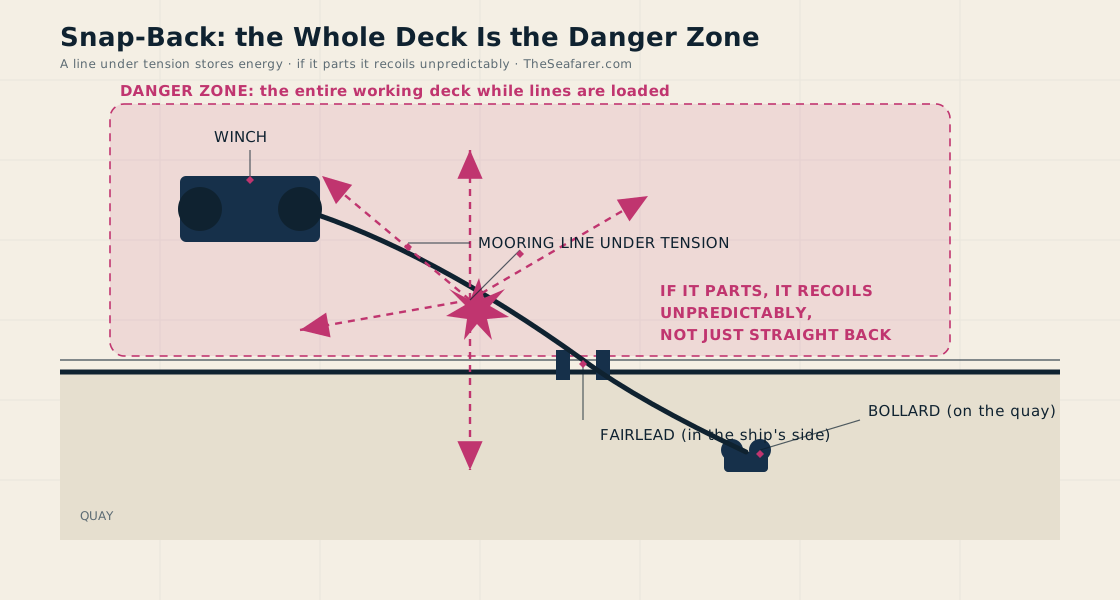
When the officer in charge calls a warning and tells you to stand clear, you move at once, without finishing what you were doing. No task on deck is worth being caught by a recoiling line.
It Is Not Only Snap-Back
Snap-back gets the attention, but it is only part of the danger, and fixating on it can blind you to the rest. Loss-prevention data from mooring injuries shows that while around half are caused by parted lines striking people, nearly as many come from ropes jumping or slipping off drum ends and bitts, or from people being caught and dragged by a moving line. That changes how you stand and where you put your hands. Never stand inside the bight of a rope, the open loop a line forms on deck, because if it comes under load it can close around a leg and take it. Keep your fingers well clear of drums, bitts, and any line that is moving, and be cautious with gloves near a turning drum, where loose material can drag a hand in. A line does not have to part to hurt you.
Communication and Commands
Mooring is a team operation run on clear, confident communication, and silence on the mooring deck is dangerous. One person, the officer in charge, gives the orders, and everyone else acknowledges and acts on them. The commands are standard and worth knowing before your first station: “heave away” to pull a line in, “slack away” to pay it out, “hold on” to stop and hold, “make fast” to secure, and “avast” to stop. You repeat back the critical ones so there is no doubt, and you call out any hazard the moment you see it. A single missed or misheard command is how a line ends up parting or a person ends up in the wrong place.
Habits That Keep You Safe on Deck
Beyond the specific dangers, good deck safety comes down to a handful of habits that become automatic with practice. Stand with your feet planted and your balance low, and watch the ship’s motion, because rolling and surging change the load on every line. Never turn your back on a line that is under tension or about to take one. Keep the deck clear of loose coils and obstructions that could trip you when you need to move fast, and always know your escape route from where you are standing. Stay off your phone and out of idle conversation while lines are being worked. None of this is complicated, but together it is what keeps a mooring deck safe, and it is the heart of practical seamanship.
Learned by Repetition
Nobody is good at line handling after one operation. The skill builds mooring by mooring, until you can feel a line about to take load through the deck, read which way the tension will move, and know without thinking where you must not stand. Experienced deck crews work with a quiet, economical coordination that looks easy and is anything but, and it is earned. Treat every mooring as a chance to sharpen that instinct, respect the forces involved, and you will become the kind of hand others trust on the deck when it matters.
Frequently Asked Questions
What is line handling? Line handling is the work of managing a ship’s mooring lines: paying them out, heaving them in, leading them through the fairleads, and making them fast to secure the ship to a berth or to work with tugs. It is a coordinated deck operation carrying heavy loads, and it is considered one of the more hazardous routine tasks aboard.
What is a snap-back zone? It is the area where a mooring line would recoil if it parted under tension. Ships once painted these zones on deck, but current guidance has moved away from marking them, because a parted line recoils unpredictably and a marked zone gave a false sense of safety. The modern approach is to treat the whole mooring deck as a danger zone when lines are loaded.
Why is snap-back so dangerous? A line under tension stretches and stores a large amount of energy. When it parts, that energy releases instantly and the broken ends whip back fast enough to kill or seriously injure anyone in the way. More elastic ropes, such as nylon, store and release the most energy and are the most dangerous, and a synthetic tail adds to the risk.
What are the main mooring lines on a ship? The standard pattern uses head and stern lines leading forward and aft to stop the ship moving off the berth, breast lines running square to the ship to hold her alongside, and spring lines leading fore and aft to stop her surging back and forth. Together they hold the vessel steady against wind and current.
How do I stay safe during a mooring operation? Know the station and its gear, never stand in the bight of a line or in the path of tension, keep clear of drums and bitts, watch the ship’s motion, keep an escape route, and respond instantly when told to stand clear. Above all, communicate clearly and treat every loaded line as dangerous.