Berthing and Unberthing
Bringing a ship alongside is the most exacting handling she does. The pivot point, the tide, the tugs, the lines that hold her, and how she springs off again
From the quayside, it can look like the easiest thing in the world: a ship glides in, lines go ashore, and she settles against the fenders as if she meant to be there all along. From the bridge it is the most demanding handling she will do all voyage. The open sea forgives a few meters; a berth does not.
Here a ship of tens of thousands of tonnes must be placed within centimeters of a concrete wall, at walking pace or slower, while wind, current, and her own vast momentum all try to put her somewhere else, and there is no sea room left to recover a mistake.
The single rule that governs all of it is unforgiving in its simplicity: you cannot berth a ship you cannot stop. Everything that follows is the craft of staying in control when control is hardest to keep.
The Maneuver With No Room for Error
Berthing is bringing a ship alongside a pier, quay, or jetty and making her fast; unberthing is letting go and taking her safely back out. Stated that plainly they sound routine, but both happen in the most constrained water a ship ever works in, hemmed by fenders, dolphins, other vessels, and shoaling ground, where a misjudgment offshore that would have cost meters now costs centimeters and paint. The forces never switch off to make it easier, so wind, tide, shallow water, and inertia all have to be handled at the exact moment there is least space to handle them.
It is also a team evolution, not a solo one. A pilot advises, the master keeps the conn and the final say, officers monitor and pass orders, the helm and engines answer, and the deck crews work the lines, all bound together by clear, continuous communication. When that coordination is good the ship seems to move by a single will, and the whole thing rests on a foundation of ordinary seamanship done well under pressure.
The Approach: Stem the Tide and Kill the Way
Berthing begins long before the berth, with a plan made on the bridge and shared with the pilot: the orientation of the berth, the state of wind and tide, the traffic, the turning room, and the way the ship will be brought in. The governing idea of a good approach is to use the elements rather than fight them, and the most important application of that idea is to stem the tide.
Wherever possible, a ship approaches against the current, because a current met head-on gives her steerage at a low speed over the ground and acts as a brake she can lean on, letting her hang almost stationary over the water while still answering the helm. Approaching with the tide behind her does the opposite, pushing her on when she most needs to slow.
The ship comes in at a shallow angle, then checks her way and swings parallel as she closes the last short distance, and through all of it the watchword is speed control. Berthing energy rises with the square of the closing speed, so a small excess of approach speed becomes a large excess of impact, and large ships are brought alongside at a transverse speed measured in a few centimeters per second, slow enough for the fenders to absorb the touch.
The skill of the approach is, in the end, the skill of stopping: arriving with the way already off her, not still trying to take it off when the wall is close.
How a Ship Turns: The Pivot Point
To control a ship in close quarters you have to know where she turns, and she does not turn about her middle. She turns about her pivot point, and the pivot point moves. When the ship is making headway it sits roughly a quarter of her length back from the bow; when she is making sternway it shifts to about a quarter of her length forward of the stern; and when she is stopped it lies near amidships. Everything else follows from where it is.
A force applied forward of the pivot point swings the bow; the same force applied aft of it swings the stern; and the further from the pivot point it acts, the greater the turning leverage. This is why a tug on the stern, a bow thruster, or simply gathering sternway can transform how the ship answers, and it is why the wind, pressing on her whole above-water profile, produces a turning moment that depends entirely on where that pivot point happens to be.
A handler who carries a clear picture of the pivot point is working with the ship; one who does not is guessing, and in a berth there is no room to guess.
The Tools: Thrusters, Tugs, and Transverse Thrust
Modern berthing leans on tools that act sideways, where the rudder and propeller mainly act fore and aft. Bow and stern thrusters push the ends of the ship across, but only at low speed; their grip falls away quickly as the ship gathers headway, so above a few knots a thruster is doing far less than the noise it makes suggests, and it is a tool for the slow final stages, not the approach. Tugs make up the difference, pushing directly on the hull or pulling on a line from forward or aft, placed deliberately relative to the pivot point so their effort turns the ship the intended way. They carry their own hazard: a tug pulled sideways by a ship still carrying way can be girted, tripped over by the tow and capsized, which is why tug work demands the same disciplined communication as everything else on the bridge.
There is also a force built into the ship herself, transverse thrust, the paddle-wheel effect of the propeller. A conventional right-handed fixed propeller, when run astern to take off the way, walks the stern bodily to port. A handler does not fight this; they use it. It is the reason a single-screw ship of that type berths most kindly port side to, because the very burst of astern power that stops her also tucks her stern in toward the quay. Knowing which way your own ship kicks, and using it at the right moment, is one of the quiet marks of a ship handler.
Made Fast: The Mooring Pattern
Once alongside, the ship is held by a pattern of mooring lines, and the pattern is not arbitrary. Each line has a job, and the jobs divide cleanly between the two ways a ship can move against a berth: along it, and off it.
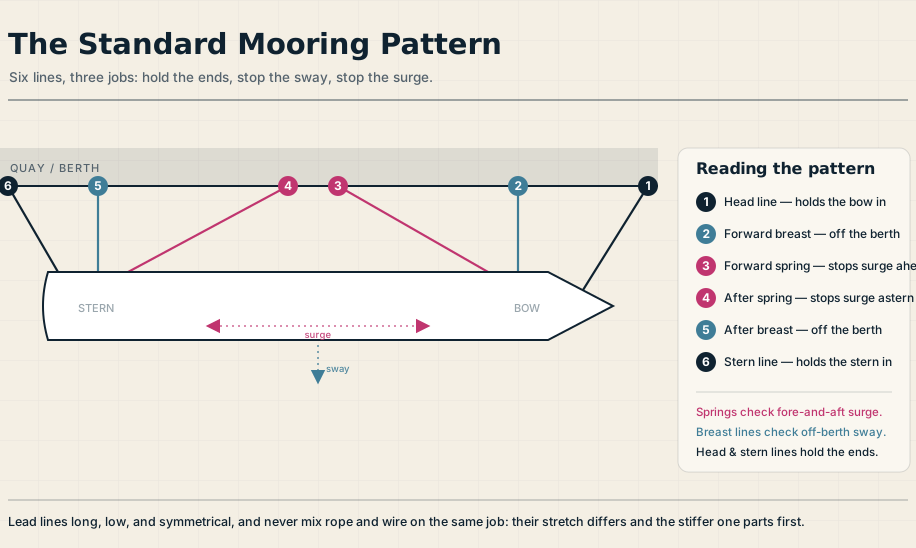

Head and stern lines run from the bow and stern to hold the ends of the ship in toward the berth. Breast lines, leading nearly straight across to the quay fore and aft, stop her moving bodily off the berth, the motion called sway. Spring lines, leading nearly fore and aft along the quay, stop her surging back and forth, the motion called surge, and they do it in both directions: the forward, or head, spring leads aft and stops her going ahead, while the after, or back, spring leads forward and stops her going astern. The guiding principle is to lead the lines long, low, and symmetrically so the load is shared evenly, and never to mix rope and wire on the same service, because their stretch differs and under load the stiffer one takes the strain alone and parts first.
Line Handling: The Deadliest Routine on Deck
It is worth stopping on the lines themselves, because handling them is among the most dangerous routine work done aboard any ship. A mooring line under tension stores an enormous amount of energy, and when one parts it whips back along its lead with lethal force. Synthetic line is especially treacherous: where a fiber rope may creak or a wire may sing in warning, nylon gives almost none, holding silently until it lets go with a single loud crack. The space a parted line will lash through is the snap-back zone, and the rule is absolute, never stand in it, and never stand in the bight of a line.
The discipline around lines is correspondingly strict. A heaving line with a weighted end is thrown to pass the first line ashore, and everyone stands clear of it. No one handles a mooring line alone, even to let it go, because the work needs more than one pair of hands and more than one pair of eyes. Lines are inspected and worn ones retired, the deck is kept clear, and the team works to called commands so that no one eases or holds a line by guess. These are not bureaucratic niceties; they are the difference between a safe mooring and a fatality, and they are the unglamorous heart of the seamanship the whole evolution depends on.
Unberthing: Springing Off the Berth
Leaving is not simply berthing in reverse, because the conditions have usually changed: a different wind or tide, new neighbors alongside, a different plan. The master and pilot reassess it all, then the ship is singled up, reduced to a single head or stern line and a single spring fore and aft, before the real work begins.
The elegant part of unberthing is using a line to do what the engines alone cannot. Held on a spring, with the rudder over and a touch of engine, a ship will lever one end off the berth while the spring holds the other: a forward spring with a little ahead movement swings the stern out, an after spring with a little astern movement swings the bow out. Once the ship has opened an angle to the berth, the last lines are let go, and thrusters, tugs, or a burst astern carry her clear into open water. Many ports then demand a turn in a basin, the ship rotated about her pivot point with rudder, thrusters, and tug pushes until she points fair down the fairway, where she gathers speed and the precision of the berth gives way at last to the freedom of the open sea. That whole sequence, read off the wind, the tide, and the pivot point and executed by a coordinated team, is what mariners mean when they call ship handling a matter of feel: not mystery, but principle made instinctive by practice.
Frequently Asked Questions
These are the questions cadets and watchkeepers ask most about berthing and unberthing, from the lines that hold a ship to the forces that move her. Here are the short answers.
What is the difference between a spring line and a breast line?
A breast line leads nearly straight from the ship to the quay and stops the ship moving off the berth, the motion called sway. A spring line leads nearly fore and aft along the quay and stops the ship surging ahead or astern, the motion called surge. Springs control surge, breast lines control sway, and head and stern lines hold the ends in.
Why do ships approach a berth against the current?
Because stemming the current gives the ship steerage at a low speed over the ground and acts as a brake. Met head-on, the current lets the ship hang almost still over the water while still answering the helm, which is exactly the control needed to place her gently. Approaching with the current behind pushes her on when she most needs to slow.
What is the pivot point of a ship?
It is the point about which the ship turns, and it moves with her motion: roughly a quarter of her length from the bow when making headway, about a quarter from the stern when making sternway, and near amidships when stopped. A force forward of it swings the bow and a force aft of it swings the stern, which is the key to handling her in close quarters.
Why do single-screw ships often berth port side to?
Because of transverse thrust, the paddle-wheel effect of the propeller. A conventional right-handed propeller run astern, the movement used to take off the way, walks the stern to port. Berthing port side to means that same astern burst both stops the ship and tucks her stern in toward the quay, working with the handler rather than against.
Why is mooring line handling so dangerous?
A line under tension stores great energy, and when it parts it snaps back along its lead with enough force to kill. Synthetic line gives little warning before it goes. The space it would lash through is the snap-back zone, and no one should ever stand in it or in the bight of a line, which is why line handling is always a disciplined team operation.