Bow Thrusters and Stern Thrusters: How They Help Ships Maneuver
A thruster buys back control at the one speed a rudder cannot work. How they swing, translate, and rotate a ship, why they fade with speed, and where their limits lie.
A rudder is useless without flow across it, and alongside a berth there is no flow. The ship is nearly stopped, the main engine is barely turning, and the one control surface that steers her has nothing to bite on.
That is the gap a thruster fills. It is not a device that makes a ship maneuverable in general; it is a tool for the single hardest moment in shiphandling, when the vessel is almost dead in the water and still needs to be moved with precision. Understanding a thruster means understanding that narrow window, and why it closes the moment the ship gathers way.
What a Thruster Actually Does
A thruster is a transverse propulsion unit built into the hull below the waterline, a propeller in a tunnel that runs athwartships, side to side. Run it one way and it draws water in on one side and pushes it out the other, producing a side force exactly where it sits.
A bow thruster puts that force near the bow; a stern thruster puts it near the stern. Most tunnel thrusters use a controllable-pitch propeller spun continuously in one direction, with the blade pitch reversed to flip the thrust from port to starboard, which responds far faster than reversing a heavy electric motor.
The force itself is modest, but its position is everything. Because it acts at the very end of the hull, far from the point the ship turns about, even a moderate side force produces a strong turning effect, the same reason a long spanner loosens a tight nut. That leverage is the whole idea, and it is also why the pivot point governs everything a thruster can do.
Swing, Translate, and Rotate: Thrusters and the Pivot Point
Every ship turns about a pivot point, a position along her length that shifts with how she is moving. Grasp where it sits and the behavior of thrusters stops being mysterious.
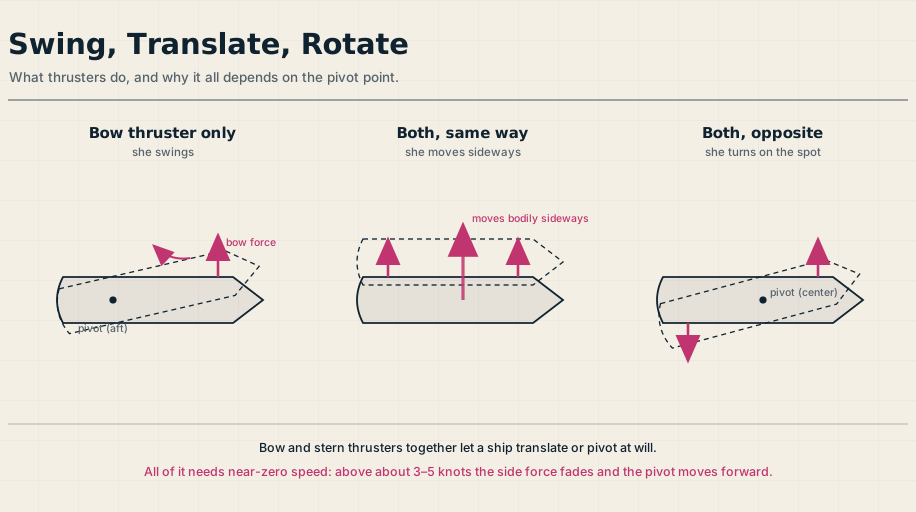
With a single bow thruster, you push the bow one way and the ship swings about her pivot, the stern moving the opposite way like a see-saw. This is the common case, since most commercial ships carry a bow thruster and nothing aft.
Fit a stern thruster as well and two new moves open up. Drive both ends the same way and the ship translates bodily sideways, sliding off or onto a berth without turning at all. Drive them in opposite directions and she rotates on the spot, turning within her own length.
That translate-or-rotate control is why ferries, offshore supply vessels, and ships that must hold an exact position carry thrusters at both ends. It lets a large vessel behave, for a few minutes, like a far smaller and nimbler craft. The same pivot-point thinking runs through all close-quarters work, which is why it is worth reading alongside the mechanics of berthing and unberthing.
Why Thrusters Fade With Speed
A thruster is a near-zero-speed tool, and it fails fast once the ship is moving. Depending on the hull and tunnel, the side force begins to collapse somewhere between 2 and 5 knots, and by the upper end of that range a bow thruster has little left to give.
Two things happen at once, and they compound. Hydrodynamically, the water flowing along the hull merges with the jet leaving the tunnel; a low-pressure region forms on the hull just downstream of the opening, and that suction sets up a turning moment that opposes the thruster, while the jet itself sweeps aft and reattaches to the hull instead of pushing the bow clear.
The second reason is geometric. When the ship is stopped, the pivot point sits well aft, so a bow thruster has a long lever arm and works well. As she gathers headway the pivot point moves forward toward the bow, shrinking that lever arm until the thruster is pushing almost on top of the very point it is trying to turn the ship about.
The practical lesson is the same from both directions: use the thruster early, while the ship is slow, and do not expect it to save you once way is on. Very large units, of around three megawatts and above, fade less sharply, but every thruster obeys the same rule.
Tunnel, Retractable, and Azimuth Thrusters
The standard fitting is the tunnel thruster just described, fixed athwartships and simple to build into the hull. Its weakness is that the open tunnel mouths add drag, noise, and vibration when the ship is at sea, which is why faster vessels, above roughly twenty knots, are often fitted with hinged orifice doors that close the tunnel flush once maneuvering is done.
A retractable thruster answers the same problem differently by withdrawing the whole unit up into the hull when not in use, removing its drag entirely at the cost of a more complex and maintenance-hungry installation.
The azimuth thruster is a different animal: a steerable pod, often retractable, that can direct its thrust through a full 360 degrees and even drive the ship ahead. Because it can point its force in any direction, it is the workhorse of dynamic-positioning and offshore vessels, where holding an exact position against wind and sea is the entire job.
The Limits, and Working With Tugs
It helps to put a number on thruster power. A rough rule gives about ten tonnes of equivalent pull per thousand horsepower, so a large bow thruster of three megawatts is worth something like a fifty-tonne tug, real force, but finite.
A high-sided ship, a car carrier or a laden box ship, presents a huge area to a beam wind, and in a strong blow that wind load can exceed what even a big thruster delivers. Other limits bite too: in a light or ballast condition the bow rises and the thruster can near the surface and draw air, losing thrust to ventilation, while shallow water and soft silt rob it of bite and a long full-power run risks overheating the motor.
This is why a thruster supplements tugs rather than replacing them. In calm, light conditions a well-found ship may berth and unberth on her thrusters alone, but when wind or current builds, the tug’s bollard pull is the muscle and the thruster merely trims the bow.
Working the two together demands care. Thruster wash can disturb a tug working close alongside or foul a line, so the discipline is the same one that underlies all of it: treat the thruster as one tool in the kit, lean on sound seamanship and good communication, and never ask the device for more than physics will give.
Frequently Asked Questions
These are the questions seafarers and cadets ask most about bow and stern thrusters, from how fast they stop working to whether they can replace a tug. Here are the short answers.
At what speed does a bow thruster stop working?
Effectiveness falls off between about 2 and 5 knots, depending on the hull and tunnel design, and by the top of that range a bow thruster has little useful force left. The flow along the hull overwhelms the jet, and the pivot point moves forward and robs the thruster of leverage, so it is strictly a low-speed tool.
What is the difference between a bow thruster and a stern thruster?
Only their position. A bow thruster applies side force near the bow and a stern thruster near the stern. A ship with just a bow thruster can swing her bow and pivot; a ship with both can also move bodily sideways or turn on the spot.
Can a ship berth without tugs if it has thrusters?
In calm weather with little wind or current, many modern ships berth and unberth on their thrusters alone. But a thruster delivers finite force, and a strong beam wind on a high-sided vessel can exceed it, so tugs are still needed in difficult conditions.
How much force does a bow thruster produce?
As a rough guide, around ten tonnes of equivalent pull per thousand horsepower, so a large three-megawatt unit is comparable to a fifty-tonne tug. That is substantial, but a laden ship in a strong tide or crosswind can still need far more.
Why do some ships have azimuth or retractable thrusters?
Retractable units withdraw into the hull to cut drag at sea, and azimuth units steer their thrust through a full circle. Azimuth thrusters in particular are used on dynamic-positioning and offshore vessels that must hold a precise position against wind and waves.