ECDIS Manufacturers: The Major Makers Explained
Every ECDIS meets the same standard, yet no two makers build the same bridge. The major manufacturers you meet at sea, and why that difference makes training type-specific.
Step onto an unfamiliar bridge and the ECDIS may look much like the one you trained on, or almost nothing like it. The chart will be the same, the safety functions will be the same, but the buttons, menus, and the way you set an alarm can be completely different.
Every ECDIS in the world meets one common standard, yet no two makers build the same cockpit around it. Understanding that gap, what is identical across brands and what is not, is more useful to a watchkeeper than any ranking of which system is best.
The Same Rules, a Different Cockpit
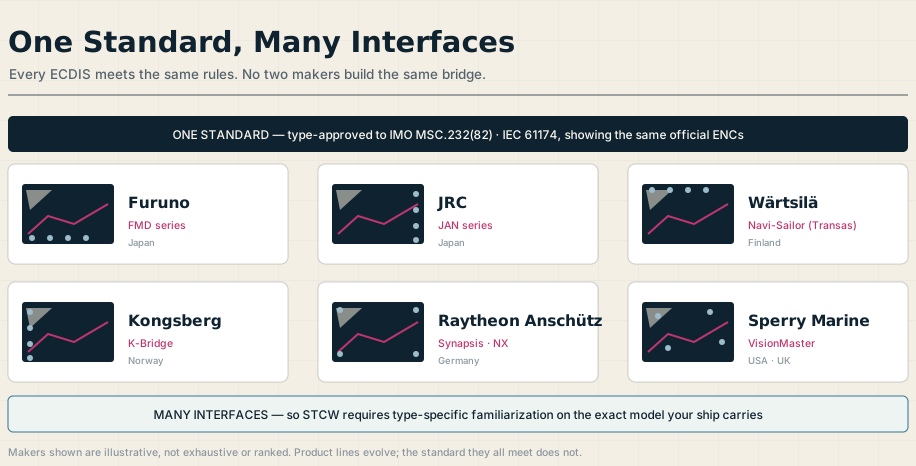
Whatever the badge on the bezel, an ECDIS is type-approved to the same IMO performance standard, MSC.232(82), and the same IEC 61174 test standard, and it displays the same official ENCs presented to the same IHO rules. The chart you see and the core safety functions behind it are, by design, common to every compliant system.
What the standard does not dictate is the interface. Each manufacturer designs its own menu structure, its own mix of hard buttons, trackball, and touchscreen, and its own workflow for everyday tasks like setting the safety contour, checking a route, or acknowledging an alarm.
The result is that two type-approved systems can demand quite different keystrokes to do the same job. The chart is standardized; the path to it is not.
The Major Manufacturers
A handful of names supply most of the world’s merchant bridges, and you are likely to meet several across a career. The makers below are a guide to the leading names, grouped roughly by where they are built, and they are neither ranked nor an exhaustive list.
Furuno
Furuno of Japan is one of the most widely fitted marine-electronics names afloat, and its FMD-series ECDIS is valued for reliability and a broad global service network. The company builds a full range of bridge equipment, so its ECDIS often sits alongside Furuno radars and sensors as part of a matched package.
JRC (Japan Radio Co.)
JRC, the Japan Radio Company, supplies its JAN-series ECDIS to commercial fleets worldwide. It integrates closely with the company’s own radars and conning displays, which makes it a common choice where an owner wants a single supplier across the bridge.
Tokyo Keiki
Tokyo Keiki is another long-standing Japanese manufacturer with a presence on merchant bridges. Alongside ECDIS it is known for gyrocompasses, autopilots, and voyage data recorders, part of the same broad marine-instrument heritage as its larger compatriots.
Wärtsilä (formerly Transas)
Wärtsilä carries the heritage of Transas, whose Navi-Sailor ECDIS and widely used navigation simulators were absorbed when Wärtsilä acquired the company. That simulation pedigree runs deep, so the same software lineage a cadet trains on ashore often reappears on the bridge at sea. Wärtsilä also took in the former SAM Electronics range as the industry consolidated.
Kongsberg Maritime
Kongsberg Maritime of Norway builds ECDIS into its wider integrated-bridge and automation systems rather than treating it as a standalone box. Strong in offshore work, dynamic positioning, and integrated navigation, the company expanded further after taking on Rolls-Royce’s commercial marine business.
Raytheon Anschütz
Germany’s Raytheon Anschütz supplies its Synapsis and newer ECDIS NX systems, built around the company’s long line of gyrocompasses and integrated bridges. It also produces naval ECDIS variants, a reminder that the technology serves warships as well as merchant hulls.
Sperry Marine
The Sperry Marine name carries a long heritage in marine navigation, from gyrocompasses and radars to its VisionMaster ECDIS line. Its systems are often seen in integrated, dual-redundant bridge configurations on larger merchant ships.
Danelec Marine and Others
Beyond the headline names sit specialists such as Danelec Marine of Denmark, better known for voyage data recorders but also an ECDIS maker, along with chart-engine and software houses whose technology runs inside other badges. The point is breadth: the fleet runs on many makes, not one, which is exactly why the brand in front of you matters.
Why the Brand Matters to You: Type-Specific Training
Here is where the interface differences stop being a curiosity and become a regulatory and safety matter. Because every system behaves differently, STCW does not treat ECDIS as a single skill you learn once.
An officer who navigates with ECDIS needs generic training, to the standard of IMO Model Course 1.27, which teaches the principles common to all systems, and then type-specific training on the particular make and model fitted to the ship. The generic course tells you what an ECDIS does; the type-specific familiarization tells you how this one does it.
That distinction has real teeth on joining day. Transferring to a ship with an unfamiliar system, even a very capable officer can be slow or mistaken until properly familiarized, which is why thorough type-specific familiarization is a standing part of joining a vessel, not an optional extra. It is also exactly what a Port State Control inspector will check.
A Consolidating Industry
The roster of names has been shrinking. Transas folded into Wärtsilä, SAM Electronics was absorbed the same way, and Kongsberg took on Rolls-Royce’s marine business, leaving fewer but larger suppliers of integrated bridge systems.
The direction of travel is toward integration and software. ECDIS is increasingly sold not as a standalone box but as one element of an integrated navigation system, bundled with route optimization, cloud-based chart management, and fleet services, and positioned for the coming generation of S-100 charts and, eventually, greater autonomy. For the officer on watch, the consequence is simply that the systems keep evolving, which makes staying current part of the job.
What This Means on the Bridge
The practical lesson from all of this is humility about the equipment. The standard guarantees that the chart and the core safety functions are sound; it does not guarantee that you know where this maker put the controls.
So treat an unfamiliar ECDIS with care, complete its type-specific familiarization before you rely on it, and always verify the settings that matter, the safety contour and safety depth, with your own hands rather than assuming the last user set them as you would. The badge changes; the discipline does not.
Frequently Asked Questions
These are the questions officers and cadets ask most about ECDIS manufacturers, from who the major makers are to why training is brand-specific. Here are the short answers.
Who are the major ECDIS manufacturers?
The leading names include Furuno and JRC from Japan, Wärtsilä (which absorbed Transas) and Kongsberg from Scandinavia, Raytheon Anschütz from Germany, and Sperry Marine, among others such as Danelec and Tokyo Keiki. No single maker dominates every fleet, and a seafarer commonly encounters several over a career.
Are all ECDIS systems the same?
Underneath, largely yes. Every type-approved ECDIS meets the same IMO and IEC standards and displays the same official ENCs, so the chart and core safety functions are common. What differs is the interface: the menus, controls, and workflows each manufacturer designs around that common core.
Why do I need type-specific ECDIS training?
Because the systems behave differently in use. STCW requires both generic ECDIS training, covering the principles, and type-specific training on the actual model fitted to your ship, since the way you set a safety contour or acknowledge an alarm varies between makers. Knowing one system well does not mean you can safely operate another without familiarization.
Which ECDIS is the best?
There is no single best, and a reference like this will not rank them. The systems compliant with the IMO standard all provide the required functions; the right choice for a ship depends on fleet standardization, the wider bridge integration, service support, and cost, which are owner and operator decisions rather than a matter of one model being universally superior.
Has the ECDIS industry changed much?
Considerably. The market has consolidated, with Transas and SAM Electronics absorbed into Wärtsilä and Rolls-Royce’s marine business taken on by Kongsberg, leaving fewer, larger suppliers. The trend is toward integrated navigation systems and software-led services rather than standalone units.