Basic Seamanship: The Complete Beginner’s Guide
From deck safety and knots to watchkeeping, mooring lines, and the rules that define good seamanship, here is the working foundation every new mariner builds a career on.
The first thing the sea teaches you is that the deck is never still. Even alongside in a calm berth, a ship breathes against her lines, and the moment you step aboard your body begins learning a new set of rules it will eventually obey without being asked.
That set of rules is seamanship. It is less a subject you study than a collection of habits you build until they keep you safe without conscious thought, and it is the foundation everything else at sea is laid on.
Good seamanship is not defined by rank. On a stormy night with spray breaking over the bow, or during a tense mooring at first light, the difference between a competent hand and a liability has nothing to do with a certificate and everything to do with whether the right habits have become automatic.
This guide walks through the fundamentals every beginner needs, the ones generations of mariners have passed down because they are the ones that keep people alive.
What Seamanship Actually Is
Seamanship is the practical craft of working safely and effectively aboard a vessel, and it draws on judgment, awareness, physical skill, and a fair amount of humility. The dictionary will tell you it is the skill of handling a ship at sea, which is true but thin. In practice, it is the whole web of competence that lets a crew read their vessel and their environment and act correctly before a situation forces their hand.
The craft spans a handful of connected areas, none of them learned from a page. They are built slowly, one task at a time, until the ship’s routines become second nature. The core skills of basic seamanship are:
- Knowing the rules of the road: the COLREGs, lights, shapes, and signals
- Knowing the ship: her layout, systems, and how she behaves in a seaway
- Moving safely on deck: keeping your footing and your hands clear of harm
- Working with lines: handling rope and deck gear, and respecting snap-back
- Tying the essential knots: a small set you can make by feel
- Standing a watch: keeping a proper lookout at all times
- Reading the sea and weather: anticipating what the ship will do next
- Working as a crew: communicating and coordinating without friction
- Being ready for emergencies: drilling the response until it is instinct
Each of these is a section in this guide, and together they are the foundation everything else at sea is laid on. The sea is indifferent to you, and a good mariner understands that competence is less about memorizing procedures than about grasping why those procedures exist, because that understanding is what lets you adapt when conditions stop matching the textbook.
Knowing the Rules of the Road
Every mariner has to know the rules that govern how ships behave around each other. The COLREGs, the international collision regulations, set out who gives way to whom, the lights and shapes a vessel shows to tell others what she is and what she is doing, and the sound signals that carry her intentions in fog or close quarters. Learning to read them is as fundamental as learning to handle a line, because a ship that misreads another’s lights is dangerous long before anyone touches a wheel.
There is also a point beginners often miss: “good seamanship” is not only a tradition, it is a legal standard. The COLREGs do not use the word “good,” but Rule 2 makes you responsible for any precaution required by the ordinary practice of seamen and by the special circumstances of the case. In plain terms, following the rules to the letter is not a defense if a competent mariner would have done more.
That has real consequences. When two vessels collide, one may be found at fault for breaking a right-of-way rule, and the other can still carry blame for failing to show ordinary seamanship, for not taking the obvious extra action that any prudent seaman would. This is why seamanship is treated as a duty rather than a courtesy. It is the expectation that you will use common sense, anticipate trouble, and act responsibly toward other vessels, even when no specific rule tells you to. Hold that idea in mind as you read the rest of this guide, because every practical skill below is an expression of it.
Knowing the Ship
Before you can work confidently, you have to understand the vessel itself, and a large ship is genuinely disorienting at first: a maze of alleyways, machinery spaces, exposed decks, and watertight doors that all look alike on day one. Your first job is simply to learn your way around until you could find your way in the dark, because one day you may have to.
Spend your early days fixing the essentials in your memory. Learn where the muster stations and escape routes are and how to reach them from your cabin and your workspace. Find the fire extinguishers, alarm points, and lifesaving gear before you ever need them. Know which spaces demand personal protective equipment and how to raise the bridge or the duty engineer on the internal phones. A good seaman always knows where they are and how to reach safety, and that knowledge has to be in place long before an emergency tests it.
Moving Safely on Deck
A ship moves under you constantly, and even a calm sea has a slow roll that will catch you off guard at first. The oldest rule in the book is “one hand for the ship, one for yourself,” and it is worth taking literally: keep a hand free for the rail or a fixed fitting whenever you move in a seaway. Never run on deck unless you are responding to an emergency, because a wet steel deck offers almost no grip.
The hazards that catch beginners are rarely dramatic. They are the line lying across the deck that rolls underfoot, the door or hatch that swings on the roll and finds a finger, the patch of oil or sea by a working space. The sea punishes carelessness in small ways first, a barked shin or a slipped step, and occasionally in ways that change a life. Treating the deck with steady respect is not timidity. It is the most basic form of seamanship there is.
Working With Lines: The Danger of Snap-Back
If you want to understand seamanship quickly, watch how an experienced hand treats a rope. Lines secure the ship, control her during maneuvers, and drive the deck machinery, and a line under load carries enormous stored energy. The single most important thing a beginner can learn about line handling is the danger of snap-back: when a synthetic mooring line parts under tension it recoils like a released spring, fast enough and hard enough to kill, and it does not always recoil where you would expect.
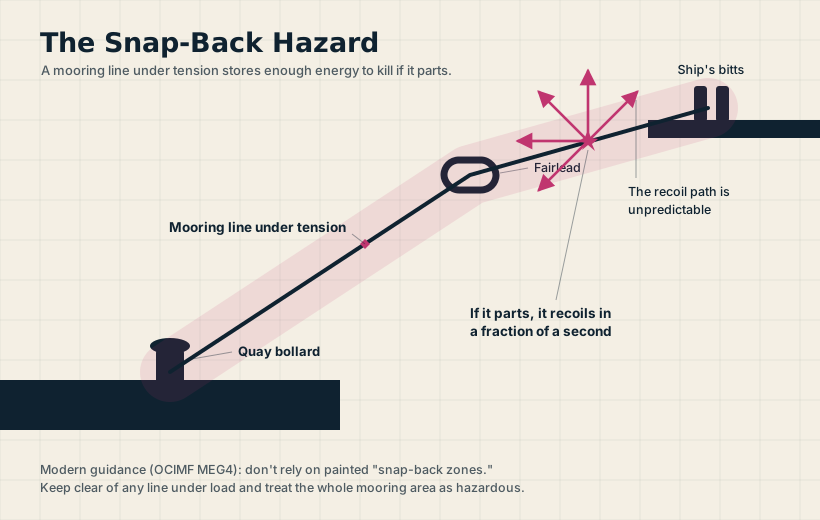
This is where older advice has changed, and you should learn the current version. Ships once painted “snap-back zones” on deck to mark where a parted line might travel, but that practice gave false confidence, because a line can recoil along paths no painted arc predicts. Modern guidance treats the whole mooring deck as a potential danger area. You stand clear of the bight, keep out of the direct line of any rope under load, and never position yourself where a part would catch you, every time, without being told. The diagram above shows why: the energy release is sudden and its direction is not something you can reliably guess.
Beyond that, the craft is in the detail. You coil and stow lines so they will run cleanly when called for, throw a heaving line accurately, and understand how winches, capstans, and bollards take and hold a load. A single mishandled line during mooring can put someone in the hospital in seconds, which is why good seamen never treat a rope as just a rope.
The Knots Worth Knowing Cold
Knots are a working language, and you only need a handful to be useful on almost any vessel. What matters is not knowing dozens but knowing these few by feel, in the dark and the wet, because the sea rarely hands you good light and dry hands when you need a knot most. Learn the five below until your fingers tie them without your eyes.
The bowline gives you a secure loop that holds under load and still comes undone afterward. To tie it, make a small overhand loop in the standing part, pass the working end up through that loop, around behind the standing part, and back down through the loop again. The old teaching line, the rabbit comes up the hole, around the tree, and back down the hole, is worth keeping in your head until your hands remember the shape.
The clove hitch secures a line to a rail or post in a hurry. Take a turn around the post, cross the working end over the standing part, take a second turn above the first, and tuck the end under that last turn so it pinches against itself. It is quick to make and quick to release, though it can work loose under a varying load, so back it up when it matters.
The reef knot, or square knot, binds two ends of equal thickness: tie right over left, then left over right. Use it for reefing and lashing, not for joining two ropes that will take a hard pull, because under load a reef knot can capsize and slip. Knowing its limits is as important as knowing the knot.
The sheet bend is the right way to join two lines, especially when they differ in size. Form a bight in the thicker line, pass the thinner working end up through the bight, around behind both parts of it, and back under itself. It holds where a reef knot would let go.
The figure-eight is your stopper, tied to keep a line from running out through a block or fairlead. Make a loop, bring the working end over the standing part and back down through the loop. It sits larger than a simple overhand and shakes out far more easily after it has been loaded. If a term in any of this is new to you, the glossary of nautical terms defines the deck vocabulary as you go.
Standing a Watch
Every vessel depends on the alertness of whoever has the watch, and the moment you take one, a share of the ship’s safety rests on you. The heart of it is keeping a proper lookout, a duty written directly into the COLREGs as Rule 5: a lookout by sight and by hearing, using every available means, at all times.
The foundations of good watchkeeping are unglamorous but absolute. Stay alert to what is around you, understand the lights and signals other ships show, watch the weather and sea state for changes, communicate clearly with the officer of the watch, and report anything unusual at once rather than waiting to be sure.
The real test of a watchkeeper comes not in busy water but in the quiet hours, when nothing is happening and the mind wants to wander. A distracted lookout is one of the most dangerous things aboard a ship, and resisting that drift is a discipline you build deliberately. The phrase to remember is that you report, you do not assume: the moment you tell yourself a contact is “probably nothing,” you have stopped keeping watch.
Reading the Sea and the Weather
A ship never operates in isolation from her environment, and learning to read it is one of the oldest skills in the trade. Wind, tide, current, swell, and visibility all shape how the vessel handles, and the beginner who only watches the instruments is missing half the picture. A wind that backs or veers changes how she steers and how she sits against a berth. A long swell on the beam makes deck work harder and more dangerous. A dark, hard line on the horizon is often a squall arriving faster than you would like.
Seamanship means watching the sea as closely as the screens, and starting to anticipate what the ship will do before she does it. The instinct to reduce speed early, to secure for weather before it arrives rather than during it, to expect the gust behind the cloud, is the difference between a crew that stays ahead of conditions and one that is forever reacting. That anticipation is the practical face of the responsibility Rule 2 describes.
Seamanship Is a Team Craft
No one is a seafarer alone. A ship is a small, working community where mooring, cargo work, maintenance, and the daily routine all depend on people coordinating without friction. Learning to take instruction cleanly, to communicate clearly, and to respect the experience of senior hands is as much a part of seamanship as any physical skill.
A steady, reliable presence earns trust quickly aboard a ship, and trust is the currency that matters when things get difficult. The hand others are glad to see on deck in bad weather is rarely the strongest or the loudest. It is the one who turns up prepared, does what was asked, and can be counted on not to add to the problem.
Being Ready When It Goes Wrong
Every mariner has to prepare for the situations they hope never to meet: fire, flooding, a man overboard, machinery failure, or the order to abandon ship. Basic seamanship is not only learning the procedures but rehearsing them until the first move is instinct rather than thought. That is what the drills are for.
Muster, fire, and abandon-ship drills feel repetitive precisely because repetition is the point: when a real emergency arrives, hesitation is the enemy, and the crew that has drilled the response simply does it. Take every drill seriously, even the routine ones, because the version of you that performs under stress is built entirely out of the version that practiced when nothing was wrong.
Where to Actually Begin
If you want to turn this into a career rather than a curiosity, there is a clear on-ramp, and it starts the moment you join a ship. Every newcomer receives safety familiarization before being assigned shipboard duties: where to muster, how the alarms sound, where the lifesaving and firefighting gear is, and how to move safely about the vessel. Nothing else proceeds until that is in place.
The standard entry qualification for working at sea is STCW Basic Safety Training, the package required under Section A-VI/1 of the international training convention. It is made up of four short courses: Personal Survival Techniques, Fire Prevention and Fire Fighting, Elementary First Aid, and Personal Safety and Social Responsibilities. Most seafarers with safety or emergency duties must hold it before they sail, and it is the first certificate almost everyone earns.
From there the path forks by ambition and by flag state, so check the exact requirements where you intend to work. Some begin as deck ratings and build sea time toward a recognized rating qualification, while others enter an officer cadetship that combines college study with supervised time aboard. Either way, the early skills in this guide are the ground the rest is built on. Our overview of merchant navy career paths lays out the routes in more detail, and our account of what life at sea is really like is worth reading before you commit.
Growing Beyond the Basics
The fundamentals here are the backbone of a mariner’s education, not the whole of it. In time you will add navigation, cargo work, stability, and shiphandling, and you will develop the judgment and instinct that turn training into real seamanship. But the striking thing about experienced mariners is how often they return to the basics: they still check their lines carefully, still keep a sharp watch, still move with care on a wet deck, and still respect the sea.
Seamanship is not mastered once and filed away. It is practiced for the length of a career, and it is where every life at sea begins.
Frequently Asked Questions
What is basic seamanship? Basic seamanship is the core set of practical skills and habits needed to work safely aboard a vessel: knowing the ship and her layout, moving and working safely on deck, handling lines and deck equipment, keeping a proper watch, staying aware of navigation and weather, and being ready for emergencies. It is the foundation every other maritime skill is built on.
What are the principles of good seamanship? They come down to preparation, awareness, anticipation, and responsibility. A good seaman readies the vessel and themselves before trouble starts, keeps a constant watch on the ship and the conditions, anticipates what is likely to happen next, and takes responsibility for acting prudently, including the extra precaution the rules expect even when no specific rule demands it.
What knots should a beginner learn first? A small set covers almost every routine need: the bowline for a secure loop, the clove hitch for quickly securing a line to a post or rail, the reef knot for joining two ends of equal size, the sheet bend for joining lines of different thickness, and the figure-eight as a stopper. Learn these few well enough to tie them by feel.
Why is line handling considered dangerous? Because a line under tension stores a large amount of energy. If a loaded mooring line parts, it snaps back fast enough and hard enough to cause fatal injuries, and not always in a predictable direction. Standing clear of the bight, keeping out of the line of any rope under load, and handling lines with proper technique is one of the first safety lessons at sea.
Do I need a qualification to start working at sea? For professional work, yes. Most seafarers must complete STCW Basic Safety Training before sailing, covering personal survival, firefighting, elementary first aid, and personal safety and social responsibilities. Beyond that, requirements depend on whether you join as a rating or an officer cadet and on your flag state, so confirm the exact path where you intend to work.
What is the difference between seamanship and navigation? Navigation is the specific discipline of fixing where the ship is and planning where she goes. Seamanship is the broader craft of working and keeping the vessel safe, which includes navigation but also deck work, line handling, watchkeeping, weather sense, teamwork, and emergency response.
What is the most important habit in good seamanship? Awareness. Knowing where you are, what is happening around you, and what the ship and the sea are about to do prevents most incidents before they start. The classic expression of it is “one hand for the ship, one for yourself,” and it captures the constant, deliberate attention that defines a good seaman.