ECDIS Carriage Requirements: SOLAS Rules Explained
Having an ECDIS on the bridge is not the same as being compliant. The SOLAS fitting timetable, the backup options, the training, and what makes it your legal charts.
A ship can have a perfectly good ECDIS on the bridge and still fail an inspection. The law does not ask whether the screen is there. It asks whether several things are true at the same time, and a missing certificate or an out-of-date chart can leave a fully fitted vessel non-compliant.
Understanding ECDIS carriage means understanding two separate things: which ships are required to fit it, and what actually counts as meeting the requirement once it is fitted.
At a Glance
When ECDIS Became Mandatory
For most of its history, an Electronic Chart Display and Information System was optional, carried voluntarily alongside paper charts. That changed with amendments to SOLAS Chapter V, Regulation 19, adopted by the IMO in 2009 and in force from 2011.
These set a phased timetable, under regulation 19.2.10, requiring ships engaged on international voyages to carry ECDIS by type and tonnage. The rollout ran over several years so that owners and the supply chain could keep pace, beginning with new passenger ships and tankers and ending with smaller existing cargo ships.
The Carriage Timetable
The deadlines split into two groups: new ships, keyed to their construction date, and existing ships, keyed to the first survey after a later date.
For new ships, the requirement applies from the construction date:
| Ship type (international voyages) | Built on or after |
|---|---|
| Passenger ships, 500 GT and over | 1 July 2012 |
| Tankers, 3,000 GT and over | 1 July 2012 |
| Cargo ships (non-tanker), 10,000 GT and over | 1 July 2013 |
| Cargo ships (non-tanker), 3,000 to under 10,000 GT | 1 July 2014 |
For existing ships, compliance was pegged to the first survey on or after a later date:
| Ship type (international voyages) | First survey on or after |
|---|---|
| Passenger ships, 500 GT and over | 1 July 2014 |
| Tankers, 3,000 GT and over | 1 July 2015 |
| Cargo ships (non-tanker), 50,000 GT and over | 1 July 2016 |
| Cargo ships (non-tanker), 20,000 to under 50,000 GT | 1 July 2017 |
| Cargo ships (non-tanker), 10,000 to under 20,000 GT | 1 July 2018 |
With the last band falling due in 2018, the phase-in is now complete for the fleet it covers. Note where the line is drawn: cargo ships other than tankers below 3,000 GT, and passenger ships below 500 GT, are not caught by the requirement, and a flag state may exempt a ship due to leave service within two years of its date.
Having a Screen Isn’t Enough
This is where many people misread the rule. Fitting an ECDIS does not, by itself, let it replace paper charts; the regulation accepts ECDIS as meeting chart carriage only when a whole set of conditions is satisfied together.
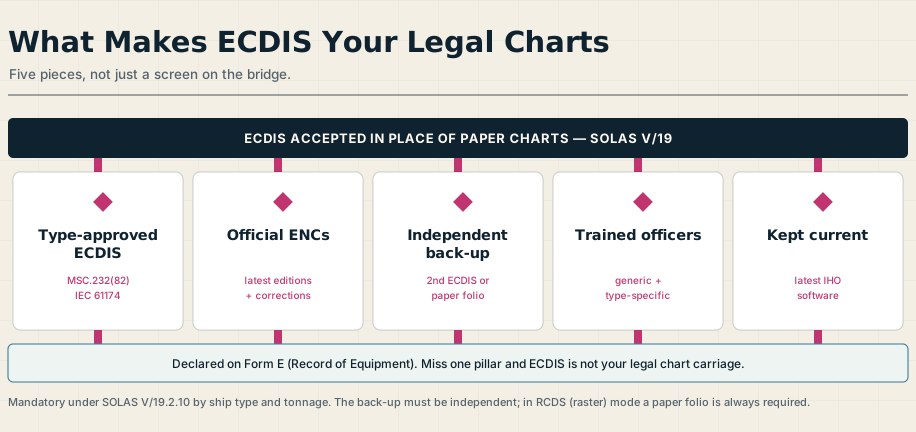
The equipment must be type-approved to the IMO performance standard MSC.232(82) and the IEC 61174 test standard, with the certificate aboard. It must display official ENCs, kept to their latest editions and corrections. There must be an independent backup, trained officers to run it, and the software kept current to the latest IHO standards. Pull out any one of those pillars and the ship is back to relying on paper.
All of this is recorded formally. The ship’s Record of Equipment, Form E for cargo ships or Form P for passenger ships, must state the means of navigation and the backup arrangement, and the entry is only completed once the vessel is fully equipped, backed up, and crewed by trained officers.
The Backup Arrangement
Because no electronic system is failure-proof, SOLAS insists on a backup whenever charts are provided by electronic means. Two arrangements are accepted, and a ship must clearly declare which one it uses.
The first is an independent, fully compliant second ECDIS, connected to both the main and the emergency power supply, which is what allows a ship to operate genuinely paperless. The second is an appropriate folio of up-to-date paper charts covering the voyage, the traditional fallback for a single-ECDIS ship.
There is one firm exception. When an ECDIS runs in raster mode using RNCs, where vector ENC coverage does not exist, a folio of up-to-date paper charts for those areas is always required, regardless of the backup chosen for the rest of the voyage.
Training and Keeping It Legal
Compliance is not only about hardware. Under STCW, officers who navigate with ECDIS must hold both generic ECDIS training, to the standard of IMO Model Course 1.27, and type-specific training on the particular equipment fitted to their ship, since one manufacturer’s interface differs sharply from another’s.
The charts and software demand ongoing attention too. ENCs must be updated to the latest notices, and the ECDIS software itself must be maintained to current IHO presentation standards, because outdated software can fail to display certain features or sound the right alarms.
Port State Control knows exactly where to look. Inspectors check the type-approval certificate, the currency of the ENCs and software, the declared backup on Form E, and the officers’ training records, and they may ask a watchkeeper to demonstrate competence by safety-checking a passage plan or showing how the route-monitoring alarms are set. Carriage compliance, in the end, is a standing condition, not a one-time installation.
Frequently Asked Questions
These are the questions officers and cadets ask most about ECDIS carriage requirements, from which ships must fit it to what makes it compliant. Here are the short answers.
Which ships are required to carry ECDIS?
Ships on international voyages, by type and tonnage, under SOLAS V/19.2.10: passenger ships of 500 GT and over, tankers of 3,000 GT and over, and cargo ships (other than tankers) of 3,000 GT and over for new builds, with existing ships phased in down to 10,000 GT by 2018. Smaller cargo ships and passenger ships below 500 GT are not required to.
Do you still need paper charts if you have ECDIS?
Only if that is your chosen backup. A ship can navigate paperless with an independent second ECDIS on main and emergency power, or it can keep an appropriate folio of up-to-date paper charts as the backup. Either way a backup is mandatory, and raster (RCDS) mode always requires paper charts.
What makes an ECDIS compliant under SOLAS?
Several things at once: type approval to MSC.232(82) and IEC 61174, official ENCs kept up to date, an independent backup arrangement, officers trained on it, and software maintained to the latest IHO standards, all declared on the ship’s Record of Equipment. Missing any one of these means the ECDIS does not satisfy the chart carriage requirement.
What training do officers need to use ECDIS?
Two kinds. Generic ECDIS training to the standard of IMO Model Course 1.27, which teaches the principles common to all systems, and type-specific training on the actual equipment fitted to the ship, because interfaces and functions vary between manufacturers.
What is the backup requirement for ECDIS?
SOLAS requires an independent backup whenever charts are provided electronically. The accepted options are a second, fully independent ECDIS powered from both main and emergency supplies, or an appropriate folio of up-to-date paper charts. The arrangement in use must be stated on the Form E or Form P Record of Equipment.