Enclosed Space Entry: The Hazards and the Procedure That Keeps You Alive
Oxygen vanishes and toxic gas collects unseen; the procedure that prevents disaster is exact, and most deaths come from skipping a single step of it.
An enclosed space gives no warning. There is no smell, no haze, no sound to tell you that the air inside a tank or a void has quietly stopped being able to keep you alive. People do not stagger back out of enclosed spaces clutching their throats. They drop where they stand, sometimes on the first breath, and the next person who climbs in to help drops beside them. This is the hazard that has killed more seafarers in port and at anchor than heavy weather ever has, and almost every death follows the same short script: someone entered a space that had not been properly tested, and someone else went in after them.
The hard truth behind every enclosed-space tragedy is that the procedure to prevent it is well understood and not difficult to follow. The deaths come from skipping a step, from a tank that “looked fine,” from a quick job that did not seem worth the paperwork. Treating an enclosed space with the respect it demands, every time, is one of the clearest marks of a professional seafarer, because the space does not give second chances.
Why an Enclosed Space Can Kill in One Breath
The danger inside an enclosed space is almost always the atmosphere, and the atmosphere can fail in three different ways. The first is oxygen loss. Air is normally 20.9 percent oxygen, and your body has very little margin below that. Rusting steel consumes oxygen, as do cargo residues, rotting organic matter, and the inert gas used to make tanks safe from explosion. A space can sit closed for a few days and quietly become unbreathable with no visible change at all. At around 16 percent oxygen your judgment and coordination start to go, often without your noticing, and in a badly depleted space a person can lose consciousness in seconds and be dead within minutes.
The second way is poison. Cargoes, fuel, decomposition, and cleaning chemicals can fill a space with toxic gas, and the most dangerous of these at sea is hydrogen sulfide, the gas associated with many oil cargoes and with sewage and stagnant water. It smells of rotten eggs at low concentrations, but at higher ones it deadens your sense of smell within moments, so the warning disappears exactly as the danger rises. Carbon monoxide, which has no smell at all, behaves the same way. The third hazard is fire: flammable vapor from cargo or fuel can build to a concentration where a single spark, even a dropped tool or static discharge, is enough. Any of these can be present in a space that looks, sounds, and feels completely ordinary, which is why your senses are worthless here and instruments are everything.
What Counts as an Enclosed Space
An enclosed space is any space with limited openings for entry and exit, inadequate natural ventilation, and a design that was never meant for people to occupy continuously. That definition covers the obvious candidates, cargo holds, ballast and fuel tanks, cofferdams, void spaces, chain lockers, pump rooms, and duct keels, but the spaces that catch experienced crews out are the ones that do not feel dangerous. A hold that has been closed up on passage, a tank that was recently inerted, a pump room after a leak: none of these announces itself. Gas can also migrate from an adjacent compartment through a leaking valve or a common boundary, so a space that tested safe yesterday is not guaranteed safe today.
The practical consequence is that you do not classify a space by how risky it feels, but by what it is. If it meets the definition, it is an enclosed space and it gets the full procedure, every time, regardless of how routine the job seems or how often the space has been entered safely before. The moment a crew starts deciding which enclosed spaces “really” need testing is the moment the system that protects them has already failed.
The Rules Behind the Procedure
The procedure for entering enclosed spaces is not local custom; it is built on hard international requirements that exist because of a long record of fatalities. Under SOLAS Regulation III/19, crew members with entry or rescue duties must take part in an enclosed space entry and rescue drill at least once every two months, so that the response is rehearsed long before it is needed. Under SOLAS Regulation XI-1/7, every ship must carry at least one portable atmosphere testing instrument capable of measuring oxygen, flammable gases or vapors, carbon monoxide, and hydrogen sulfide, used to test a space from the outside before anyone goes near it.
Sitting above the mandatory regulations are the IMO’s detailed recommendations for how entry should actually be done, and this is where the guidance has recently changed. In 2025 the IMO adopted Resolution MSC.581(110), which revised and replaced the long-standing recommendations in Resolution A.1050(27). The newer resolution updates the entry and gas-testing procedures and, importantly, requires each ship to keep a specific enclosed space register and an emergency response plan, which the master is expected to verify before authorizing any entry. Underneath all of it, the ISM Code obliges the company’s safety management system to identify these hazards and set safeguards against them. The point of the framework is simple even if the references are not: entry is a controlled operation with named responsibilities, not a task anyone improvises.
Testing and Ventilating the Atmosphere
Everything depends on the atmosphere, and the atmosphere is checked before a single boot goes over the coaming. Testing is done from outside the space using the ship’s portable instrument, and it is done at several levels, top, middle, and bottom, because gases stratify: heavier-than-air vapors like many hydrocarbons and hydrogen sulfide pool low, while a single reading at the manway can look reassuring while a lethal layer sits at the bottom of the tank. A space is only acceptable for entry when the instrument shows an oxygen reading of 20.9 percent by volume, flammable vapor no greater than 1 percent of the lower flammable limit, and any toxic gas below its occupational exposure limit. An oxygen reading below 20.9 percent is not an invitation to enter carefully; it is a signal that something is consuming the oxygen and the space is not safe.
The diagram below shows how the pieces fit together at the point of entry.
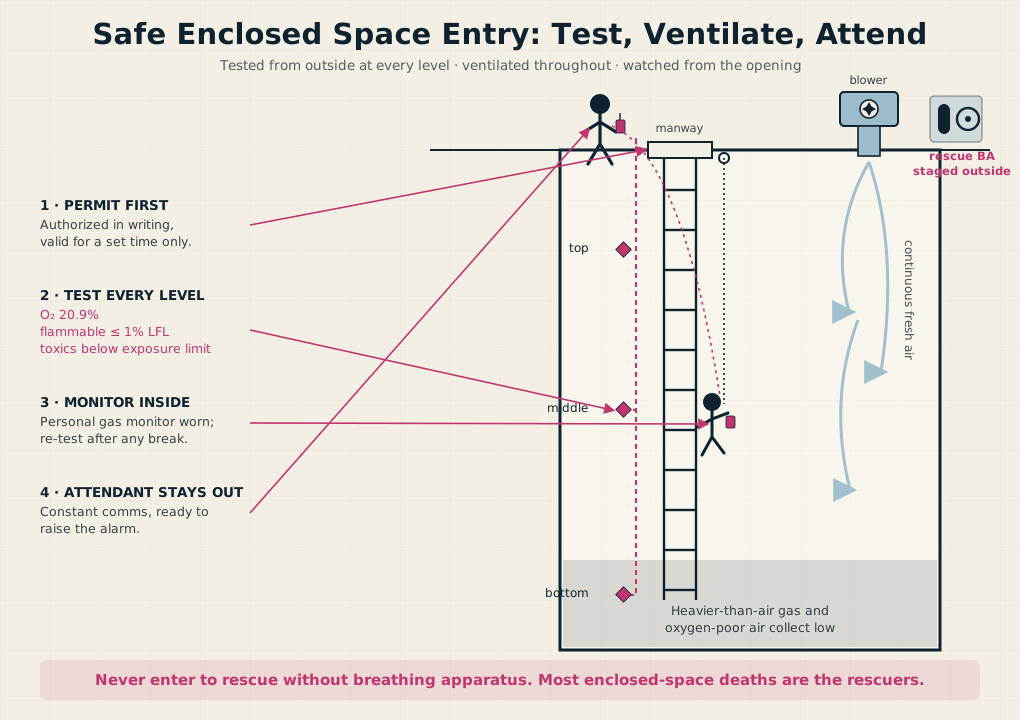
A clean test result is a snapshot, not a guarantee, so two things continue the whole time the space is occupied. Ventilation runs before entry and stays running throughout, keeping fresh air moving so that nothing can accumulate. And every person inside carries a personal gas monitor that alarms the instant the atmosphere shifts, because conditions can change with the tide, with temperature, or with the work itself. If the space is left and re-entered, or if anything about the job changes, it is tested again. There is one more principle that newcomers often get backward: routine entry is into an atmosphere that has been made safe, not an atmosphere you survive by wearing breathing apparatus. Breathing apparatus belongs to rescue and to tightly controlled special cases, not to ordinary work in a space that should have been ventilated and tested clean first.
The Permit and the People
Because so much has to be confirmed, enclosed space entry is governed by a written authorization, and on most ships this is part of the permit to work system. The permit is not paperwork for its own sake; it is a checklist that forces someone competent to confirm, before entry, that the space has been tested and ventilated, that equipment and communications are in place, that a rescue plan exists, and that entry is authorized for a defined period. When that period lapses, or the job is interrupted, the authorization stops and the space must be reassessed before anyone goes back in.
The permit also assigns the people, and one role matters above all others. An attendant stays at the entrance for the entire operation, in constant communication with the people inside, watching the conditions, and ready to raise the alarm. The one thing the attendant must never do is enter the space after a casualty, because that single instinctive act is what turns one victim into two. Everyone involved wears the protective equipment the job requires, and where hot work is involved in or near the space, it runs under its own stricter controls covered in the guide to hot work safety. The system works precisely because no single person is left to make a life-or-death judgment alone in the moment.
When It Goes Wrong: Rescue
Despite every precaution, casualties happen, and how the crew responds in the next sixty seconds decides whether there is one victim or several. The statistic that should be tattooed on every seafarer’s memory is that studies of enclosed-space and confined-space deaths consistently find a majority of the dead are would-be rescuers, often cited at around six in ten. They die because the sight of a collapsed colleague overrides training, and they climb in without testing and without air. The discipline that saves lives is brutally counterintuitive: you do not go in. You raise the alarm, start the rescue team, and bring the casualty out using breathing apparatus, a retrieval line, and people who are trained and equipped for exactly this.
This is the entire reason the two-monthly drills exist, and the reason they are worth taking seriously even when they feel like a box to tick. A rescue from a tank is awkward, slow, and physically hard, and the first time a crew works out how to get a limp casualty up a vertical ladder should never be during a real emergency. An enclosed space is built into the ship by necessity. Respecting it, testing it, and never entering it on instinct is built into seamanship by hard experience, and it is the kind of discipline that keeps a crew whole.
Frequently Asked Questions
What is an enclosed space on a ship? An enclosed space is any space with limited openings for entry and exit, inadequate natural ventilation, and a design not intended for continuous occupancy. Examples include cargo holds, ballast and fuel tanks, cofferdams, void spaces, chain lockers, pump rooms, and duct keels. A space is treated as enclosed because of what it is, not because of how dangerous it happens to feel.
What are the main hazards of enclosed space entry? The principal hazards are atmospheric: oxygen deficiency caused by rust, cargo, inert gas, or decomposition; toxic gases such as hydrogen sulfide and carbon monoxide; and flammable vapor that can ignite from a spark. These hazards are invisible and often odorless, which is why entry depends on instruments rather than the senses. Physical hazards such as ladders, poor lighting, and obstructions add to the risk.
What oxygen level is safe for entry? Air is normally 20.9 percent oxygen, and that full reading is what a space should show before entry. A reading below 20.9 percent means something is consuming the oxygen and the space is not safe until the cause is found and corrected. Alongside oxygen, flammable vapor must be no more than 1 percent of the lower flammable limit, and any toxic gas must be below its occupational exposure limit.
Why do so many enclosed-space deaths involve rescuers? Because the instinct to help a collapsed colleague is overwhelming, and a would-be rescuer who enters without testing and without breathing apparatus is overcome by the same atmosphere that took the first casualty. Studies consistently find that a majority of confined-space fatalities are rescuers. The correct response is never to enter: raise the alarm and use a trained, equipped rescue team with breathing apparatus and retrieval gear.
Is a permit always required to enter an enclosed space? Yes. Entry is authorized through a permit to work that confirms the atmosphere has been tested and ventilated, equipment and communications are ready, an attendant is posted, and a rescue plan is in place. The permit is valid for a defined period, and the space must be reassessed before re-entry if that period lapses or conditions change.