Abandon Ship Procedure
Leaving the ship is the last resort, not the first. Here is the order it follows, from the general alarm to the survival craft, and why the master alone decides.
The hardest thing to teach a seafarer about abandoning ship is when not to. Every instinct in an emergency screams to get off the burning, flooding, listing steel and into something that floats.
Yet the ship, even badly hurt, is almost always the best survival craft aboard, and the sea has taken more sailors who left too early than ever went down with a vessel that could have stayed afloat. A liferaft is a thin tube of fabric on a hostile ocean. The ship is steel, with food, shelter, radios, and a known position.
The old wisdom puts it bluntly: you step up into the liferaft, meaning you do not leave until the deck is going under and the raft is rising to meet you. Abandoning ship is the last resort, and understanding the procedure begins with understanding how reluctant a good crew is to use it.
The Last Resort, Not the First
Ships are engineered to survive damage. Watertight subdivision, fire boundaries, pumps, and a trained crew mean that most fires can be contained and most flooding can be controlled. The moment a crew gives up the ship, they give up every one of those advantages and trade a damaged but floating platform for an open boat. That is why the decision is never taken on fear alone, and why ships have survived hours and even days longer than their crews expected.
The procedure that follows exists to do one thing: turn the worst moment of a sailor’s life into an ordered sequence of actions that can be carried out calmly, even as the deck tilts and smoke fills the passageways. None of it is improvised. All of it is drilled, monthly and in every weather, precisely so that the body knows what to do when the mind is flooded with adrenaline.
Before the Order: Buy Time, and Send the Distress
Long before anyone reaches a lifeboat, the response is already in motion. The general emergency alarm, seven short blasts and one long on the ship’s whistle and alarm bells, sends everyone to their muster stations carrying a lifejacket or immersion suit and the equipment assigned against their name on the muster list, the posted document that gives every crew member a station and a job. While the crew musters, the emergency teams keep fighting, cooling fire boundaries or shoring against the water, because every minute they buy is a minute the ship stays an option.
One action in this phase matters more than the original sequence often makes clear: the distress goes out early. The bridge transmits a Mayday and a digital selective calling (DSC) alert, activates the EPIRB, the satellite beacon that gives rescue coordinators the ship’s identity and position through the Cospas-Sarsat system, and switches on the SART, the transponder that lets a rescuer’s radar home in on the survival craft. Portable VHF radios are gathered to take into the boats. The reason for haste is simple. The systems that call for help need power, antennas, and a known position, and all three may be gone in the final minutes. Sending the distress while the ship still has them, rather than waiting until the lights fail, can be the difference between a coordinated rescue and a search for people no one knows are there. It is the same instinct that drives the immediate position-marking in a man overboard response: fix where help must come, before the chance is lost.
At the Muster Station: Order Out of Chaos
The muster station is where discipline meets panic and, in a well-run ship, wins. Crew don their lifejackets, fitted with a light, whistle, and reflective tape, or climb into immersion suits if the water is cold, a suit that must be donned in under two minutes and that can extend survival time in cold water from minutes to hours. The station leader counts heads and reports the number to the bridge, because accountability now prevents an impossible problem later: nobody wants to discover a missing shipmate after the boats have pulled away.
Officers brief their teams on what is happening and what may come next, and that briefing does more than pass information. It steadies people. A crew that knows the situation, however bad, holds together better than one left to imagine it. This is the quiet payoff of every drill run on a calm afternoon, that the actions feel familiar when the deck no longer does.
The One Order Only the Master Gives
There is no heavier command at sea, and maritime law reserves it for one person. Only the master can order abandon ship, because only the master holds the whole picture: the structural state of the hull, the fire boundaries, the rate of flooding, the weather, the position of rescue, and the ship’s remaining chance of survival. If the master is incapacitated, that authority passes to the chief officer, but the principle holds. The decision belongs to one voice.
This is also where a crucial point is often misunderstood. The general alarm does not mean abandon ship. SOLAS defines no separate sound signal for leaving the vessel; the alarm only musters the crew. The order to abandon is the master’s spoken command, given over the public address and passed by word of mouth, clear and repeated so there is no ambiguity. Until that verbal order comes, no one boards a boat or releases a craft. The sound brings the ship’s company together; only the master’s words send them over the side.
Into the Boats: Survival Craft and Launching
When the order is given, the crew moves from muster stations to their assigned survival craft, and the movement is deliberate, not a rush, because panic at this stage causes the injuries and delays that cost lives. The sequence from the first alarm to the open water follows a fixed shape, and it is worth seeing as a whole.
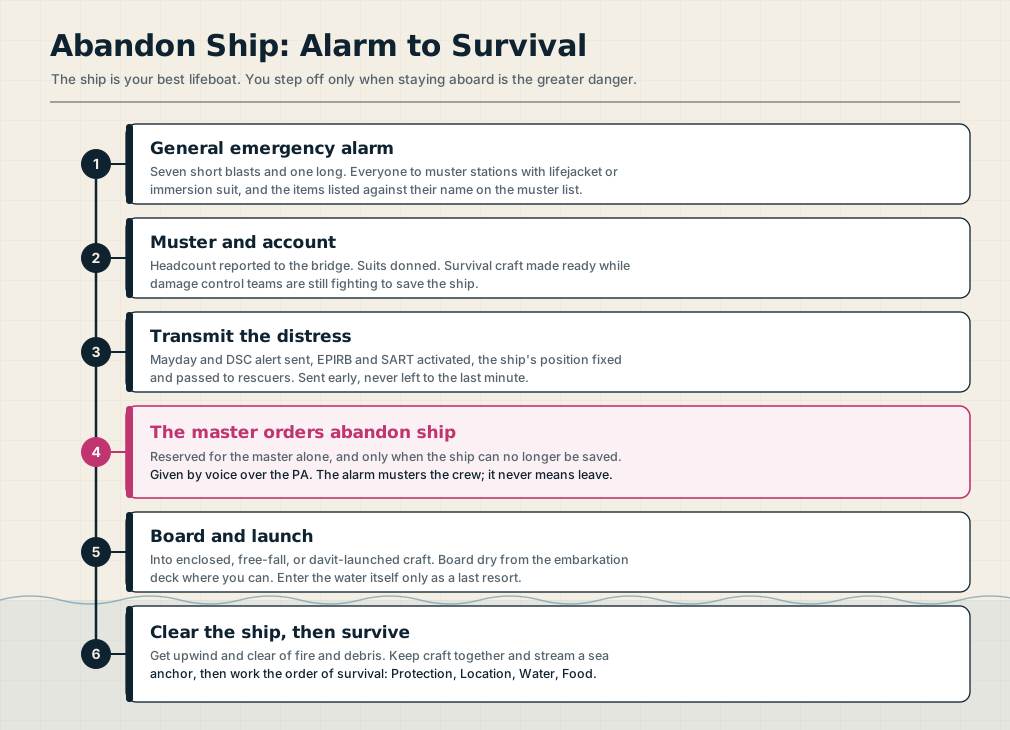
Ships carry different craft, and the launch differs with each. Enclosed lifeboats on gravity davits are swung out and lowered to the embarkation deck, where crew board dry, then lowered to the water on the falls before the release gear lets them go. Free-fall lifeboats, common on bulk carriers and tankers, take a different approach: the crew straps in, and the boat is released to slide down a steep ramp and plunge into the sea, a violent but highly reliable way off a sinking ship. Liferafts are thrown over the side still in their canister and inflate when the painter line is pulled hard, and if the ship goes down before they can be launched, a hydrostatic release unit frees them automatically as she sinks, so they float clear and inflate on their own. On passenger ships, marine evacuation systems use chutes and slides to move large numbers quickly into waiting rafts.
The guiding rule through all of it is to stay dry if you possibly can, boarding the craft directly rather than entering the water, because immersion is the threat that cold turns deadly. If there is no choice but to jump, you jump feet first, one hand sealing your nose and holding the lifejacket down, eyes on a clear patch of water, from the lowest safe height. The first minute in cold water brings the same cold shock response that makes immersion so dangerous in any survival situation, which is exactly why the immersion suit and the dry boarding matter so much.
Clearing the Ship, and Staying Alive: Protection, Location, Water, Food
Getting into the boat is not the end of the emergency. It is the start of survival. The first task is to get clear: pull upwind and away from the ship, beyond the reach of fire on the water, falling debris, and the disturbance a large vessel makes as she goes down. Craft are then brought together and tied off, because several rafts lashed as one are easier to spot, easier to keep accounted for, and a source of shared warmth and morale.
From there, survival runs in a clear order of priorities, and the order matters because it reflects what actually kills people adrift.
- Protection comes first, because exposure and hypothermia take lives long before thirst or hunger. Close the canopy, bail the craft dry, use the thermal protective aids, and huddle together to hold heat.
- Location comes second: keep the EPIRB and SART working, hold the portable VHF for when rescuers are near, stream a sea anchor to slow the drift and stay close to the position already transmitted, and save the flares for the moment a ship or aircraft is actually in sight.
- Water comes third, rationed carefully, never drawn from the sea no matter the thirst.
- Food comes last, the least urgent of the four. Through all of it, steady leadership and small assigned tasks keep people calm, because survival at sea is as much a test of the mind as the body, and a crew that left a stricken ship in good order tends to endure in good order too.
Frequently Asked Questions
These are the questions crews and cadets ask most about abandoning ship, from who gives the order to how survival is prioritized once the boats are away. Here are the short answers.
What is the signal to abandon ship?
There is no separate sound signal for abandon ship. The general emergency alarm, seven short blasts and one long, sends everyone to muster stations, but the order to leave the vessel is the master’s verbal command over the public address. The alarm alone never means abandon ship; only the master’s spoken order does.
Who can give the order to abandon ship?
Only the master, because only the master has the full picture of the ship’s condition, the weather, and the chance of survival. If the master is incapacitated, the authority passes to the chief officer. No one boards or launches a survival craft until that order is given.
Why is it dangerous to abandon ship too early?
A damaged ship usually offers far more protection than a lifeboat or raft, with shelter, supplies, radios, and a known position. Ships often stay afloat much longer than expected, and entering the sea or a small craft exposes the crew to cold, capsize, and the difficulty of being found. More lives have been lost leaving too soon than staying with a ship that could float.
What should you take when abandoning ship?
A lifejacket or immersion suit is essential, along with the equipment assigned on the muster list. The crew brings the means of rescue to the boats: the EPIRB, the SART, portable VHF radios, and pyrotechnics. Extra protection such as thermal protective aids, blankets, and any rations and water specified also go across.
What is the order of survival priorities in a lifeboat?
Protection, location, water, then food. Protection from exposure comes first because cold kills fastest. Location means staying findable, keeping beacons and radios working and craft together. Water is rationed and never taken from the sea. Food is the least urgent, since people endure far longer without it than without warmth or rescue.