Flooding and Damage Control
A breach is only the beginning. What decides whether a ship survives is how the crew holds her watertight boundaries and fights water's pull on her stability.
Fire announces itself. Flooding does not. There is no smoke, no heat, often no alarm at the start, just a sound that should not be there: a hiss behind a bulkhead, a trickle in a space that has always been dry, the slow change in how the ship answers the sea.
By the time water is obvious, it is already winning, because the danger of flooding is not only the weight of the water coming in. It is what that water does to the ship’s stability once it is loose inside her, and a surprisingly small amount, free to move, can roll a ship over long before she is anywhere close to full.
Damage control is the practiced discipline of stopping that process early, and it rewards crews who understand the physics as much as the procedure.
Why a Trickle Is a Threat
Water gets into ships in many ways: collision, grounding, a failed sea valve or pipe, a cracked weld worked open by heavy weather, a sea chest that lets go. Whatever the source, two things follow. The water adds weight, pulling the ship deeper and reducing the reserve buoyancy that keeps her afloat. And it forms a free surface, a moving sheet of water that attacks her stability directly. The second effect is the one that catches crews out, because it does not depend on how much water is aboard so much as how freely it can move.
A ship is built to survive this. Under SOLAS Chapter II-1, hulls are divided by transverse watertight bulkheads into separate compartments, so that a breach floods one space and the others hold her up. That subdivision is the ship’s designed defense, a series of sealed boxes that contain damage. But the design only works if the crew preserves it. Damage control, at its heart, is the work of keeping flooding inside the box it started in.
The First Minutes: Detect, Report, Contain
The strongest defense against catastrophic flooding is finding it early, and detection is often human before it is electronic. A watchkeeper notices a list that was not there an hour ago, a roll that has gone sluggish, a draft reading that has crept up, or simply the sound of water where there should be none. Bilge alarms and level sensors back this up, but the trained ear and eye frequently get there first.
The instant flooding is suspected, it is reported, without waiting to confirm how bad it is. Delay is the one mistake that cannot be recovered, because inflow only grows. Raising the alarm brings the ship to her emergency stations and puts the damage control organization to work. Almost in the same breath comes containment: closing the watertight doors and valves around the affected space to set a boundary, exactly as a fire team sets boundaries around a fire. Watertight doors are kept closed at sea for this reason, and they are built to be closed even with the ship listed up to 15 degrees, and to be shut remotely from the bridge, so a single command can seal the subdivision before anyone reaches the scene.
Reading the Casualty: Where, How Fast, How Bad
With a boundary set, the damage control party works out what they are facing. The first question is where the water is entering, which is not always obvious; a breach can hide behind machinery, under deck plates, or inside insulation, and the team traces it by watching how the water moves. The second question is how fast, because inflow rate measured against available pumping capacity decides the entire strategy. If pumps can move more water than is coming in, the space can be won. If inflow exceeds capacity, pumping alone will never lower the level, and the effort has to shift to stopping the water at its source and holding the boundaries instead.
Entering a flooded space to find all this out is its own hazard. Water hides sharp steel, open gratings, and missing deck plates, and it may be in contact with energized electrical equipment, so power is isolated before anyone goes in. A flooding compartment can also become an enclosed-space trap, with the same atmospheric dangers covered in the enclosed space procedures, so the team treats entry with the same caution. Throughout, the bridge watches the bigger picture, tracking list, trim, and draft, and using the ship’s onboard stability computer to model the damaged condition and see where the margins are going.
The Physics That Decides It: Free Surface Effect
To understand why flooding is so dangerous so early, you have to understand what loose water does to a ship’s stability. This is the free surface effect, and it is the single most important idea in damage control.
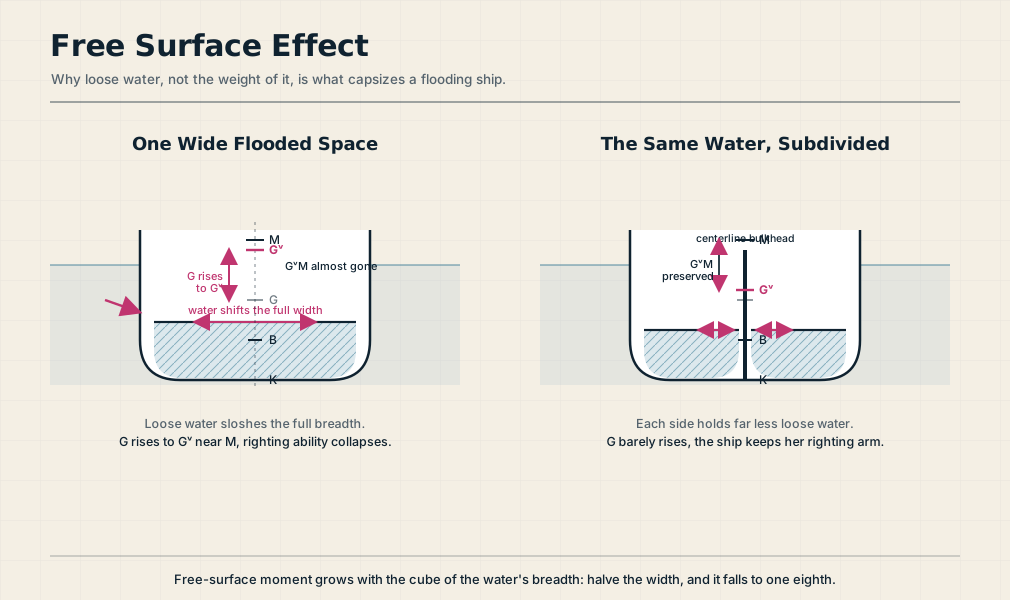
A ship stays upright because her center of gravity sits below her metacenter, giving her a righting arm that pushes her back when she heels. Put a sheet of loose water inside her, and every time she rolls, that water runs to the low side. Its weight shifts with her, and the effect is exactly as if her center of gravity had climbed upward toward the metacenter. This virtual rise of G eats directly into her righting arm. Let it rise far enough and the righting arm vanishes, or goes negative, and she lolls or capsizes, even though she may be nowhere near sinking from the weight of water alone.
The cruel part is how the math works. The free surface moment depends on the breadth of the water sheet cubed, not on its depth. A wide, shallow film of water across a full compartment is devastating, while the same volume confined to a narrow space barely matters. Halve the width that water can travel, and you cut its destabilizing moment to one eighth. This is why subdivision saves ships, and why the worst thing you can have is a single broad flooded space with water free to slosh from side to side. It also explains a fact that surprises people: a compartment flooded completely solid, with no free surface left, can be less dangerous to stability than the same compartment half full, though the added weight and lost buoyancy bring their own peril. The enemy is the moving surface, and the whole art of damage control is to remove that water or pin it down.
Holding the Line: Watertight Integrity and Progressive Flooding
If subdivision is the ship’s defense, then progressive flooding is how that defense is defeated, and it is the quiet killer in most flooding casualties. Water rarely respects the neat boundaries of the plan. It finds the door someone left open, the ventilation duct that runs between compartments, the cable penetration that was never properly sealed, and it spreads from the damaged space into spaces that should have stayed dry. A ship that could have survived one flooded compartment is lost when the water reaches the second and the third.
The boundaries that matter most run up to the bulkhead deck, the uppermost deck to which the watertight bulkheads are carried, with the margin line drawn just below it as the limit the waterline must not reach. Above and around these boundaries sit the openings that decide everything: air pipes, vents, and ventilators that, once they dip below the rising waterline, let water pour in from above and flood the ship from the top down. These downflooding points are why a ship can be lost to progressive flooding while her hull bulkheads still hold. Holding the line means knowing every one of these openings and boundaries cold, which is the real reason crews drill the ship’s damage control plan until it is second nature.
Fighting the Water: Plug, Patch, Shore, and Pump
Once the situation is understood, the crew goes to work on the water itself, and the order matters: stop the inflow first, then remove what is already aboard. The ship’s damage control locker holds the tools for the first job, soft wooden wedges and plugs driven into cracks and around leaking pipes, shoring timbers and adjustable steel props braced against a weakened bulkhead or a patch to hold it against the sea’s pressure, and patches of canvas, rubber, or steel pressed over a breach. For a hole in the hull below the water, a collision mat can be hauled down the outside of the ship, where the sea’s own pressure holds it against the opening, while a cement box poured around an internal leak can set even underwater to seal it.
Only once the inflow is checked does pumping turn the tide. Ships carry bilge pumps, portable submersible units, and emergency pumps, and the damage control officer matches them to the job, watching for the clogged suction or the lost prime that can stop a pump dead. Pumping is also where firefighting and flooding meet, because water poured into a ship to fight a fire is itself a free surface waiting to form. More than one ship has been saved from fire only to be threatened by the weight and movement of the water used to fight it, which is one reason flooding and firefighting are trained as two halves of the same stability problem.
The Last Resort: Counter-Flooding and the Decision to Save the Ship
Sometimes flooding is asymmetric, filling one side and throwing the ship into a dangerous list. Many ships are built with cross-flooding arrangements, self-acting ducts designed to let water flow to the opposite side and equalize the heel quickly, within minutes, before the list becomes unrecoverable. Where these are not enough, the crew may resort to deliberate counter-flooding, intentionally flooding selected spaces on the high side to bring the ship back upright. It is a calculated gamble, made on the numbers from the stability computer and on the master’s authority, because adding water to save the angle also adds weight and steals away the reserve buoyancy that keeps her afloat. Done wrong, it sinks her faster. Done right, it buys the stability to survive.
When flooding finally exceeds everything the crew can do, the priority shifts from saving the compartment to saving the people. The master declares a distress and brings in search and rescue and any ship within reach, drawing on the same mutual aid that underpins the rest of the safety and survival discipline at sea. Even then, damage control does not stop, because every minute the ship is kept afloat is a minute that makes an orderly evacuation possible. Keeping her up long enough for everyone to get off is, in the end, a damage control victory too.
Frequently Asked Questions
These are the questions crews and cadets ask most when working through flooding and damage control, from the physics of why water is so dangerous to the tools used to fight it. Here are the short answers.
What is the free surface effect in simple terms?
Free surface effect is what loose water does to a ship’s stability. As the ship rolls, water free to move inside her runs to the low side, which acts as if her center of gravity has risen and cuts into her ability to right herself. It depends on how wide the water can travel, not how much there is, so even a shallow sheet across a wide space is dangerous.
Why is a half-flooded compartment sometimes worse than a full one?
Because the danger is the moving surface, not the weight alone. A partly flooded space has a large free surface that shifts as the ship rolls and steadily destroys her righting arm. Once a space is completely full, that surface disappears, so a solidly flooded compartment can be less of a stability threat than a half-full one, even though the added weight and lost buoyancy remain serious.
What is the difference between cross-flooding and counter-flooding?
Cross-flooding uses built-in, often self-acting arrangements designed to let water equalize automatically to the opposite side and limit heel within minutes of damage. Counter-flooding is a deliberate decision by the crew to flood chosen spaces on the high side to correct a dangerous list. It is a last resort, because it trades away reserve buoyancy to buy back stability.
How does a ship survive flooding by design?
Under SOLAS Chapter II-1, the hull is divided by watertight bulkheads into separate compartments, so a breach floods one space while the others keep the ship afloat. The design works only if the crew preserves those boundaries by keeping watertight doors closed and stopping water from spreading through openings and ducts into undamaged spaces.
What tools are used to stop flooding?
The damage control locker holds wooden wedges and plugs for cracks and leaking pipes, shoring timbers and steel props to brace weakened structures and hold patches in place, and soft or rigid patches for breaches. A collision mat can be rigged over a hull hole from outside, and a cement box can seal an internal leak. Pumps then remove the water, but only once the inflow has been controlled.