The Herald of Free Enterprise Disaster: The Capsize That Changed Maritime Safety
She left Zeebrugge with her bow doors open and capsized in ninety seconds, killing 193. How it happened, why so fast, and the safety culture the disaster forced into law.
On a calm evening in March 1987, a roll-on/roll-off ferry left a Belgian harbor and capsized within minutes, killing 193 people. Nothing about the sea that night caused it. The weather was good and the water was sheltered.
The Herald of Free Enterprise went over because she sailed with her bow doors open, and because the system around that single failure was rotten enough to let it happen. The disaster became one of the most important turning points in the history of maritime safety, and almost every deck officer still works under rules written in its aftermath.
What Happened
The Herald was a Spirit-class roll-on/roll-off passenger and freight ferry, built for fast loading on the cross-channel routes and operated by Townsend Thoresen. On 6 March 1987 she was working from Zeebrugge to Dover, with 80 crew, 459 passengers, and around 130 vehicles aboard. She left her berth in the inner harbor at 18:05, passed the outer mole at 18:24, and capsized about four minutes later.
The chain that killed her was short. The assistant boatswain, whose job was to close the bow doors, had gone to his cabin during the turnaround and fallen asleep, and he did not wake to the call for harbor stations. The chief officer, responsible for seeing the doors shut, left the vehicle deck for the bridge assuming the work would be done.
From the wheelhouse, the captain could not see the bow doors and had no indicator to tell him their position, so he took the ship to sea believing all was well. As she built speed past the breakwater, the bow wave rose over the open door sill and seawater poured onto the vehicle deck.
Why She Capsized So Fast: The Free Surface Effect
What turned an open door into a capsize in about ninety seconds was the free surface effect, and it is the single most important thing to understand about this disaster. A roll-on/roll-off vehicle deck runs the full length and breadth of the ship with no watertight bulkheads to break it up, because that open space is exactly what makes rapid vehicle loading possible.
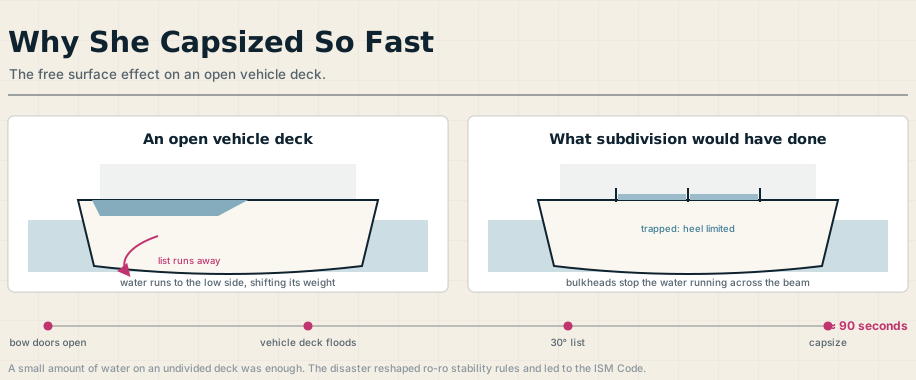
On such a deck, water does not sit still. As the ship leans even slightly, the water runs to the low side, and the weight of it shifts the ship’s balance and pulls her further over, which sends more water to the low side again. The list feeds itself and runs away. A relatively small amount of water, free to move across that wide undivided deck, was enough to destroy the Herald’s stability and roll her onto her side, where she came to rest on a sandbar in shallow water with half the hull above the surface. Had the deck been broken up by watertight subdivision, as the hull below it was, the water would have been trapped in smaller pockets and the heel contained, which is precisely the lesson that damage control and modern ro-ro design take from her.
The Real Cause Was Not One Sleeping Man
It is tempting to lay the disaster at the door of the sleeping assistant boatswain, and the inquiry did find him negligent. But that reading misses the point entirely, and missing it is how disasters repeat. The captain and chief officer failed too, and behind all three stood a company that had built a system in which a single human slip could sink a ship.
The warnings had been ignored for years. The masters had repeatedly asked for indicator lights on the bridge to show whether the bow doors were open or closed, and management had dismissed the request, reasoning it was wasteful to spend money confirming whether staff had done their jobs. A sister ship had sailed with her bow doors open in 1983 after the same role-holder overslept, and other vessels in the fleet had done likewise. The hazard was known, documented, and live, and nothing had been done to design it out.
The Sheen Inquiry and the Disease of Sloppiness
The formal investigation was led by Mr Justice Sheen, and its conclusions reached far above the men on board. It found serious negligence by the master, the chief officer, and the assistant boatswain, and it found the owners themselves at fault, judging that the underlying causes lay higher up in the company than on the ship.
Sheen’s most quoted finding was that, from top to bottom, the organization was infected with what he called the disease of sloppiness. It was a damning phrase because it located the real failure not in a moment of inattention but in a whole culture that tolerated shortcuts and ignored its own masters. A later attempt to prosecute the company for corporate manslaughter collapsed, because the law of the day could not pin the failure on a single controlling mind, but the case helped drive the reform of corporate manslaughter law that followed years afterward.
What Changed: The Rules Written After
The response was swift and lasting. Within days, ferries were forbidden from leaving port with their loading doors open, and indicator lights and closed-circuit cameras were fitted so the bridge could finally see what the masters had asked to see for years. The United Kingdom took the lessons to the International Maritime Organization, and amendments to SOLAS followed on door monitoring and the damage stability of ro-ro ships, a process that a second tragedy, the loss of the Estonia in 1994, would later force much further. Britain also created the Marine Accident Investigation Branch to investigate casualties independently.
The deepest change was cultural and became law. The Herald, more than any single event, drove the creation of the International Safety Management Code, adopted by the IMO in 1993 and made mandatory under a new chapter of SOLAS from 1998. The ISM Code requires shipping companies to run documented safety management systems, with clear responsibilities, procedures for critical tasks, and accountability that reaches from the deck to the boardroom. It exists because Sheen’s “disease of sloppiness” had to be answered with something more than a rule about doors, and much of the permit and procedure culture at sea today flows from it.
The Lesson That Outlived the Ship
The Herald of Free Enterprise turned maritime safety from a matter of following individual rules into one of managing safety as a system. The disaster proved that a competent crew, a seaworthy ship, and good weather are not enough if the organization around them tolerates the small, normalized failures that line up into catastrophe.
That is why “it is only paperwork” is one of the most dangerous sentences anyone can say on a ship. The checklists, the door checks, the handovers, and the management systems that can feel like bureaucracy were paid for in lives on a sandbar off Zeebrugge, and they exist so that one person falling asleep can never again be enough to drown 193 people. Of all the lessons in maritime safety, few are written more plainly than this one.
Frequently Asked Questions
These are the questions people ask most about the Herald of Free Enterprise disaster, from what caused it to what it changed. Here are the short answers.
What caused the Herald of Free Enterprise to capsize?
She sailed from Zeebrugge with her bow doors open. As she built speed, the bow wave washed seawater onto the open vehicle deck, and the free surface effect of that water destroyed her stability, capsizing her in about ninety seconds. The assistant boatswain who should have closed the doors was asleep, and no system caught the error.
How many people died on the Herald of Free Enterprise?
193 passengers and crew died, many from hypothermia in the cold water. It was the deadliest peacetime disaster involving a British merchant ship in modern times, and 367 of the roughly 560 people aboard were rescued.
What is the free surface effect?
It is the loss of stability caused by liquid moving freely across a wide space inside a ship. As the ship heels, the water runs to the low side, shifting weight and increasing the list, which can run away into a capsize. An undivided ro-ro vehicle deck makes the effect especially dangerous, which is why the Herald went over so quickly.
What safety changes came from the Herald of Free Enterprise disaster?
Ferries were banned from sailing with loading doors open, and bridge indicator lights and cameras were fitted. SOLAS was amended on door monitoring and ro-ro stability, the UK created the Marine Accident Investigation Branch, and the disaster drove the International Safety Management Code, which made company safety management systems a legal requirement.
What was the Sheen Report?
It was the official inquiry into the disaster, led by Mr Justice Sheen. It found negligence by the master, chief officer, and assistant boatswain, and fault by the owners, famously concluding that the company was infected from top to bottom with a culture of sloppiness, locating the real cause in management rather than in one crew member.