Firefighting at Sea: A Seafarer’s Guide to Emergency Response
Fire behaves differently inside a steel hull. Here is how to read it, which agent fights which class, and the drills that turn panic into procedure.
Ashore, a fire is someone else’s emergency. You dial three digits and a trained brigade arrives in minutes. At sea there is no one to call. The nearest fire service may be a thousand miles of open water away, and the people who will fight the fire are the same people now standing in the alleyway with the alarm ringing in their ears. That single fact, that the crew is the entire fire department, shapes everything about how ships are built, equipped, and drilled against fire.
Why Fire at Sea Is a Different Enemy
A ship may be close to the worst place imaginable to have a fire. The whole structure is steel, which conducts heat efficiently from one compartment into the next. Spaces are confined and stacked tight, so heat and smoke build with nowhere to go. Ventilation trunking can carry flame and smoke the length of the vessel in minutes. Fuel, lube oil, paint, chemicals, and cargo sit behind almost every door, and the routes out are few. A spark that would be a nuisance ashore can become a vessel-threatening emergency before the kettle has cooled.
That is why fire protection is one of the most heavily regulated areas of ship design. SOLAS Chapter II-2 and the FSS Code (the International Code for Fire Safety Systems) govern how ships are subdivided, detected, and equipped against fire, and they exist because the margin for error at sea is so thin. Understanding the systems they require is the difference between a contained incident and a lost ship.
The Fire Tetrahedron: Break One Side and It Collapses
Most of us first learn the fire triangle: heat, fuel, and oxygen, the three things every fire needs. The more complete model adds a fourth side, the chemical chain reaction that sustains combustion once it starts, which turns the triangle into a tetrahedron. It matters because every firefighting agent you will ever use works by removing one of those four sides.
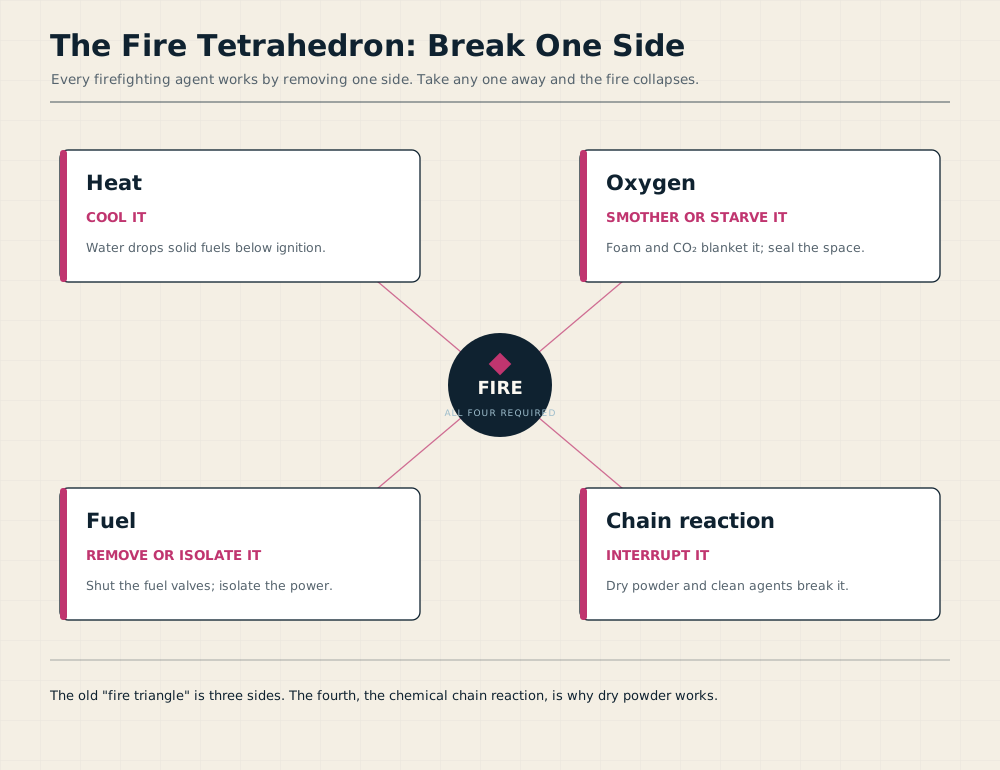
Cooling removes heat, which is what water does to burning solids. Smothering or starving removes oxygen, which is how foam and fixed gas systems work. Isolating removes fuel, which is why shutting a fuel valve can do more than any hose. Dry powders and clean agents interrupt the chain reaction itself. Once you see a fire as four sides rather than a single problem, the right tool stops being a guess.
Knowing What You Are Fighting: The Classes of Fire
Identifying the class of fire is not an academic exercise. Reach for the wrong agent and you can spread the fire, trigger an explosion, or kill yourself. Maritime training uses the international classification, and it is worth getting the labels right because they differ from the American system you will also see in print.
Class A is solid combustibles: wood, cloth, paper, and most plastics, which are cooled with water. Class B is flammable liquids such as fuel, oil, and paint, where water is dangerous because it spreads the burning liquid, so you use foam or dry powder to blanket and smother it. Class C is flammable gases, where the first move is to shut off the supply rather than extinguish the flame and risk an unburned gas cloud. Class D is burning metals, certain cargoes and machinery components, which react violently with water and need specialized dry powders. Class F is cooking oils and fats in the galley, where water flashes the hot oil into a fireball, so wet-chemical agents are used to cool and seal the surface.
Electrical fires are deliberately not a class of their own. Electricity does not burn; the wiring and equipment around it do. So you isolate the power first, then fight whatever is actually alight as a Class A or B fire using a non-conductive agent such as CO₂. One caution on terminology: the American system labels energized electrical fires as Class C and cooking oils as Class K, so a publication’s “Class C” can mean two different things depending on where it was written.
The Ship’s Firefighting Arsenal
A ship carries a deliberately layered set of tools, from something one person can grab to systems that flood an entire compartment. Knowing the location, operation, and limits of each is a basic professional expectation, not advanced knowledge.
From Extinguishers to Fixed Systems
Portable extinguishers are the first response, sited throughout the vessel for the fire you find in its first seconds. The habit that matters is approaching with care, testing the extinguisher before you commit, and aiming at the base of the flames rather than the tips. Behind them sits the fire main: hydrants and hoses fed by fire pumps, which deliver the continuous water you need for cooling and suppression. Ships carry more than one pump for redundancy, including an emergency fire pump in a space separate from the main machinery, so that a fire in the engine room cannot rob you of the water you need to fight it. Hose handling is a skill in itself, awkward in tight spaces and harder still in heavy weather.
Fixed systems are the heavy artillery: CO₂ total-flooding for machinery and cargo spaces, water mist, high-expansion foam, and inert gas on tankers. The most important thing to understand about a fixed CO₂ system is that it puts the fire out by displacing the oxygen, which means it will asphyxiate anyone left inside just as effectively as it smothers the fire. It is released only after a full headcount confirms the space is clear, the boundaries are sealed and ventilation stopped, the specific alarm has sounded, and the master has given the order. No one re-enters until the space has been cooled, ventilated, and had its atmosphere tested. One recent change worth noting: from the first survey after 1 January 2026, firefighting foams containing PFOS are banned, so older foam stocks are being replaced with fluorine-free alternatives.
Breathing Apparatus and the Fireman’s Outfit
You cannot fight a serious fire without protecting your lungs, and smoke makes a compartment unbreathable long before flame reaches it. Self-contained breathing apparatus (SCBA) gives you that protection: a positive-pressure set with a cylinder of roughly 1,200 liters, around 30 minutes of working air, fitted with a low-air alarm that warns you before the cylinder drops below 200 liters. Wearing it is physically hard, and the only way to stay calm and efficient inside a smoke-filled space is to have trained until the apparatus feels routine.
The fireman’s outfit, now more often called the firefighter’s outfit, is the full kit: fire-resistant protective clothing, boots, gloves, a rigid helmet, a safety lamp, and an axe, alongside the SCBA. SOLAS II-2 requires at least two outfits aboard, more on larger ships and tankers, and they must be inspected monthly and kept ready in an accessible place, the same discipline you apply to maintaining and inspecting all your protective equipment. Do not confuse the SCBA with an EEBD, the emergency escape breathing device. An EEBD holds only ten to fifteen minutes of air and exists for one purpose: getting you out of a smoke-filled space. You never fight a fire on one.
The Fire Party: Who Does What
No one fights a shipboard fire alone, and the structure that prevents it is the muster list, which assigns every crew member a role before the ship ever sails. When the alarm sounds, people do not decide what to do; they go to a job they already know.
The attack team approaches and tackles the fire directly, always working in pairs, in breathing apparatus, on a lifeline, in constant communication. The back-up team stands ready to relieve them, reinforce them, or go in after them if conditions turn. The boundary cooling team works the spaces around the fire, and the support team runs out hoses, manages ventilation, handles communications, and keeps equipment flowing forward. Each fire party carries at least two two-way radios. The buddy system and the lifeline are not formalities. They are how the attack team comes back out.
The First Minutes: From Alarm to Attack
Early detection is what gives a crew a fightable fire instead of an inferno. Smoke and heat detectors, alongside routine patrol rounds, exist to catch fire in the minutes when it is still small, and what happens in those minutes usually decides the outcome.
When a fire is found, the sequence is raise the alarm, inform the bridge, and, if it can be done safely, contain it by closing doors, dampers, and fire flaps to starve it of air and stop smoke spreading. Then the organized response unfolds under the fire plan and the muster list. Speed matters enormously, because a fire grows while you hesitate. But containment comes before commitment: an attack team that rushes in without boundary cooling behind it and a charged hose in hand simply becomes the casualty the back-up team now has to rescue.
Inside the Compartment: Smoke, Heat, and Boundary Cooling
Smoke kills more people at sea than flame does. It blinds you, it disorients you, and a few breaths of it can incapacitate you, which is why entering a smoke-filled compartment is done with method, not courage alone.
Stay low, where the air is cooler and clearer. Feel a door or bulkhead with the back of your hand before opening it, because a hot door means fire behind it and an inrush of fresh air can flash the compartment over the moment you open up. Keep a charged hose, never lose your line back to the exit, and never remove your mask. Throughout, the team coordinates ventilation with the bridge, since fans and dampers can either feed the fire or clear an escape route depending on how they are set.
Containing the spread is often as important as extinguishing the fire. Heat travels through steel quickly, so a fire shut inside one compartment can ignite the next without a flame ever crossing the boundary. Boundary cooling, playing water on the surrounding bulkheads, decks, and the overhead, is the patient, unglamorous work that stops this happening. The structural fire protection built into the ship, the A, B, and C-class divisions that resist fire for set periods, is designed to buy you exactly this time, but only if the fire doors are actually closed when it starts.
Drills, Discipline, and the Last Resort
Everything above is theory until it is rehearsed, and the regulations treat training as seriously as equipment. SOLAS requires a fire drill at least once a month, with every crew member taking part, and within 24 hours of leaving port if more than a quarter of the crew is new to the ship; passenger ships drill weekly. The point of a realistic drill is muscle memory, the ability to act calmly and correctly when the real alarm sounds and there is no time to think.
Discipline is what keeps the equipment ready between drills: fire doors closed, extinguishers in date, detectors working, breathing apparatus charged. Abandoning a burning ship is the genuine last resort, reached only when the fire is beyond control and the vessel can no longer be made survivable, and a crew exhausts every option before it gets there. That, in the end, is why the drills and the discipline matter so much. The whole system exists so that the decision to leave is one you almost never have to make. The sea does not forgive complacency, and at sea, you are the fire service. Train like it. Read alongside the rest of the safety and survival reference to keep the whole picture sharp.
Frequently Asked Questions
A few questions come up on this topic more than any other, usually from cadets meeting the systems for the first time and officers double-checking the intervals. Here are the short answers.
How often are fire drills required at sea?
SOLAS requires a fire drill at least once a month, with every crew member taking part in one drill each month. If more than 25 percent of the crew have not drilled on that ship in the previous month, a drill must be held within 24 hours of leaving port. Passenger ships drill weekly.
Why can’t you just use water on every fire?
Because water makes some fires worse. On burning liquids it spreads the fuel and carries the flame; on a galley fat fire it flashes the hot oil into a fireball; on energized electrical equipment it conducts and can electrocute you. Match the agent to the class: foam or dry powder for liquids, wet chemical for cooking oils, and isolate the power before tackling anything electrical.
What is the difference between SCBA and an EEBD?
An SCBA, self-contained breathing apparatus, gives roughly 30 minutes of working air and is worn to enter smoke and fight fire. An EEBD, emergency escape breathing device, holds only around ten to fifteen minutes of air and exists solely to get you out of a smoke-filled space. You never fight a fire on an EEBD.
Why is releasing a fixed CO₂ system so serious?
A fixed CO₂ system floods a space and extinguishes the fire by displacing the oxygen, which means it will asphyxiate anyone still inside. It is released only after a full headcount confirms the space is clear, the boundaries are sealed and ventilation stopped, the alarm has sounded, and the master gives the order. No one re-enters until the space has cooled, been ventilated, and had its atmosphere tested.
What is boundary cooling?
Boundary cooling is playing water on the bulkheads, decks, and overhead around a fire to stop heat conducting through the steel and igniting the next compartment. It does not extinguish the fire directly, but it contains it and buys time, which is often what saves the ship.